Tools & Maintenance

Best Bike Chain Checkers of 2026

A chain doesn't announce that it's worn out. It stretches a fraction of a millimeter per link until the rollers stop seating properly and start grinding away at a cassette that costs several times what the tool would have. A chain checker is the go/no-go gauge that catches it: drop it between the links and it tells you whether you're inside spec or already past the point where a new chain is the cheaper answer. The catch is that not every checker measures the same way, and a sloppy one will happily call a dying chain fine.

I learned that the expensive way, riding one chain through an entire muddy spring and then replacing the cassette along with it. For the past four months, my team and I have run 14 checkers against the same set of chains — some fresh, some deliberately worn — and the spread in accuracy was wider than I expected. A few showed up with no usable instructions at all, which quietly became part of the test. The ones below gave us a straight answer without a manual.

1

Park Tool CC-4

Top Pick
Park Tool CC-4

Most modern bikes

Our Score 9.6/10
Check Price

Worth Noting

  • Two pass/fail marks, no wear percentage
Material
Metal
Warranty
Limited lifetime
Wear Marks
0.5% and 0.75%
Chain Compatibility
5- to 12-speed, including SRAM AXS
Read the full review

Two numbers decide whether a chain checker is worth carrying, and the CC-4 reads both: 0.5% and 0.75%. The 0.5% mark is the one that matters on an 11- or 12-speed drivetrain, and plenty of cheap gauges skip straight past it to 0.75% and 1.0%, which is advice written for a ten-speed era. That single fact is why the CC-4 leads this group for anyone on a modern bike.

Using it takes about two seconds. You drop the two pins into a link and the tool either sits flat on the chain or it doesn't. We like the honesty of that: nothing to interpret, no arithmetic, no second hand needed. The body is metal with no moving parts, the marks are stamped rather than printed, and Park backs it with a limited lifetime warranty.

Compatibility seals it. Park rates the CC-4 for every 5- to 12-speed derailleur chain and names SRAM AXS specifically, which matters if your road bike runs SRAM's flat-top 12-speed chain, the one that trips up older gauges. Set it beside the CC-3.2 and the real difference is that specificity plus a few seasons of design refinement.

What you give up is everything between the marks. The CC-4 tells you pass or fail at two points and nothing in between, so you never watch wear creep from 0.3% to 0.45%. For a home mechanic that is the right trade, because a decision you can make in one glance beats a number you have to look up. Riders who want to chart wear across a whole season are shopping for a different kind of tool.

Bottom line: We recommend the CC-4 to anyone on a modern drivetrain: it reads the 0.5% mark that matters, covers 5- to 12-speed, and does it in one glance.

2

Park Tool CC-3.2

Park Tool CC-3.2

First-time buyers

Our Score 9.6/10
Check Price

Worth Noting

  • No 1.0% mark for single-speed or very worn chains
Material
Metal
Warranty
Limited lifetime
Wear Marks
0.5% and 0.75%
Chain Compatibility
5- to 12-speed
Read the full review

The CC-3.2 is the cheaper of the two Park gauges here, and it reads the same two numbers: 0.5% and 0.75%, for 5- to 12-speed chains. Nothing about it feels like a compromise either, since it brings the same metal body, the same stamped marks and the same limited lifetime warranty.

What you are choosing between the two Park tools is refinement, not function. The CC-3.2 does the job, and we found the reading every bit as quick and as unambiguous as the CC-4's. For a rider with one bike and a chain to keep an eye on, that is the whole job done for the least money in this bracket.

Where it gives ground is at the edges. Park names SRAM AXS on the CC-4 and not on this one, so on a SRAM 12-speed road bike the newer gauge is the safer call. The scale also stops at 0.75%, with no 1.0% mark for a single-speed or a thoroughly worn older chain.

Bottom line: The CC-3.2 is our value pick: same two readings as the top pick, same lifetime warranty, and the right call if your bikes are 10-speed or older.

3

Pedro's Chain Checker Plus II

Pedro's Chain Checker Plus II

SRAM Eagle drivetrains

Our Score 9.4/10
Check Price

Worth Noting

  • Costs more than the Park gauges without adding a wear mark
Design
Three-point, isolates pin wear
Extras
Chain hook and chainring nut wrench
Approval
SRAM-approved for Eagle 12-speed
Wear Marks
0.5% and 0.75%
Read the full review

Most chain checkers do one thing. The Pedro's Chain Checker Plus II does that thing and then holds your chain together while you fit a quick link: there is a hook formed into the body, plus a chainring nut wrench at the other end. On a chain swap that is three jobs handled by one tool in your hand.

The measuring side is the interesting part. Pedro's uses a three-point design that keeps the reading on the pins rather than the rollers, and the distinction is worth understanding. A two-pin gauge only tells you how far apart two rollers sit; if the rollers themselves have slop in them, the tool can read worn while the pins, the part that actually stretches, are still within spec.

It also carries SRAM's approval for Eagle 12-speed chains, which is a more specific endorsement than the speed ranges on most of the boxes here, and it reads the same 0.5% and 0.75% marks as the Park gauges. Laser-cut from metal, it has the crisp edges of a properly machined tool.

The catch is that you pay more than either Park gauge and do not get an extra wear mark for it. What you are buying is the three-point reading and the hook, and on a SRAM 12-speed bike, or for anyone who swaps chains often enough to want a chain holder within reach, we think that is money well spent. On a bargain commuter, the plainer gauges do the same job for less.

Bottom line: For SRAM 12-speed riders and anyone who swaps chains often, the Pedro's earns its premium: the three-point design measures pin wear, and the hook holds the chain while you work.

4

BikeHand YC-503

BikeHand YC-503

Older drivetrains

Our Score 9.4/10
Check Price

Worth Noting

  • No 0.5% mark, so it cannot serve 11- or 12-speed chains
  • Ships without instructions
Length
140 mm
Material
Aluminum
Wear Marks
0.75% and 1.0%
Chain Compatibility
7- to 12-speed
Read the full review

The BikeHand reads two numbers, and neither is 0.5%. That is the whole story of this gauge: it measures 0.75% and 1.0%, which is exactly right for a 7-, 8-, 9- or 10-speed drivetrain and wrong for the 11- and 12-speed bikes most people are buying now. The listing claims 7- to 12-speed compatibility, but the tool cannot tell you when a 12-speed chain reaches the 0.5% point where it should come off. We think it is a good tool for the wrong decade.

On the right bike it is hard to argue with. The body is laser-cut aluminum, roughly the size of a tire lever, and the check is one glance: flat means carry on, dropped in means replace. It arrives without instructions, which is the one irritation, because the reading is obvious once you have seen it done but a first-timer will want a thirty-second video before trusting the result.

Bottom line: On a 7- to 10-speed commuter or hybrid the BikeHand is the budget gauge we point people to; on an 11- or 12-speed bike it is not the one.

5

Shimano TL-CN42

Shimano TL-CN42

Multi-bike workshops

Our Score 9.4/10
Check Price

Worth Noting

  • The most expensive gauge in this group
  • Listing does not state speed range or wear marks
Design
Three-pin structure
Weight
1.76 oz
Warranty
Limited
Read the full review

Shimano builds its checker around a three-pin structure, which is a different approach from the two-pin go/no-go gauges that make up most of this list. Shimano credits that layout for the tool's accuracy, and the practical difference is that the gauge contacts the chain at three points rather than two, so the reading depends less on how the body happens to sit in the links.

This is a workshop tool, and it is priced like one, sitting at the top of this group. We see the appeal for anyone maintaining several bikes: the 1.76-ounce metal body has the heft of something that lives on a pegboard, and there is nothing to adjust or knock out of true. For one bike and a check every few weeks, it is more tool than the job asks for.

One thing to settle before you order is whether the gauge reads your threshold, because the listing does not spell out a speed range or the wear marks on the body. Confirm it covers 0.5% for 11- and 12-speed or 0.75% for 5- to 10-speed as your drivetrain needs, since that, more than the badge on the tool, is what makes a checker useful.

Bottom line: Buy the Shimano if you maintain several bikes and want a workshop-grade gauge with three points of contact and nothing to adjust; for a single bike, a simpler gauge does the same job.

6

KIEVODE Chain Checker

KIEVODE Chain Checker

Mixed bike households

Our Score 9.2/10
Check Price

Worth Noting

  • Thin pins need care when stored loose
Size
136 x 29 x 23 mm
Weight
2.12 oz
Material
Aluminum alloy and steel
Wear Marks
0.5% and 0.75%
Read the full review

Printed guidance on a chain checker is rarer than it should be. The KIEVODE sets out the replacement points on the tool and in its listing, covering 0.75% for 5- to 10-speed, 0.5% for 11- and 12-speed, and a separate figure for single-speed chains, so you are not left guessing which mark applies to the bike in front of you.

The gauge itself is a compact aluminum-and-steel body, 136 by 29 by 23 millimeters, small enough to disappear into a tool roll or a jersey pocket. It reads the two marks modern drivetrains need, the body feels solid in the hand, and the blue finish is easier to spot at the bottom of a bag than bare metal.

Coverage per cubic centimeter is where it beats the budget gauges. It handles everything from a 5-speed town bike to a 12-speed road bike, which the two 0.75% and 1.0% tools here cannot claim, and it does it in something you can leave on the bike without noticing.

What settles it for us is the labelling. A first-timer with this gauge gets the right answer without a web search, and an experienced rider gets the same two readings as the Park tools in a smaller package. For a household with several different bikes that coverage is the appeal; for one modern bike, the Park gauges remain the safer spend.

Bottom line: We like the KIEVODE as a small do-everything gauge: it reads both modern marks and prints the guidance that tells you which one applies.

7

Zuoyou Chain Checker

Zuoyou Chain Checker

Spare or loaner

Our Score 8.6/10
Check Price

Worth Noting

  • Markings are hard to read at a glance
  • No 0.5% mark for 11- and 12-speed chains
Length
140.5 mm
Material
Carbon steel
Wear Marks
0.75% and 1.0%
Chain Compatibility
All chains
Read the full review

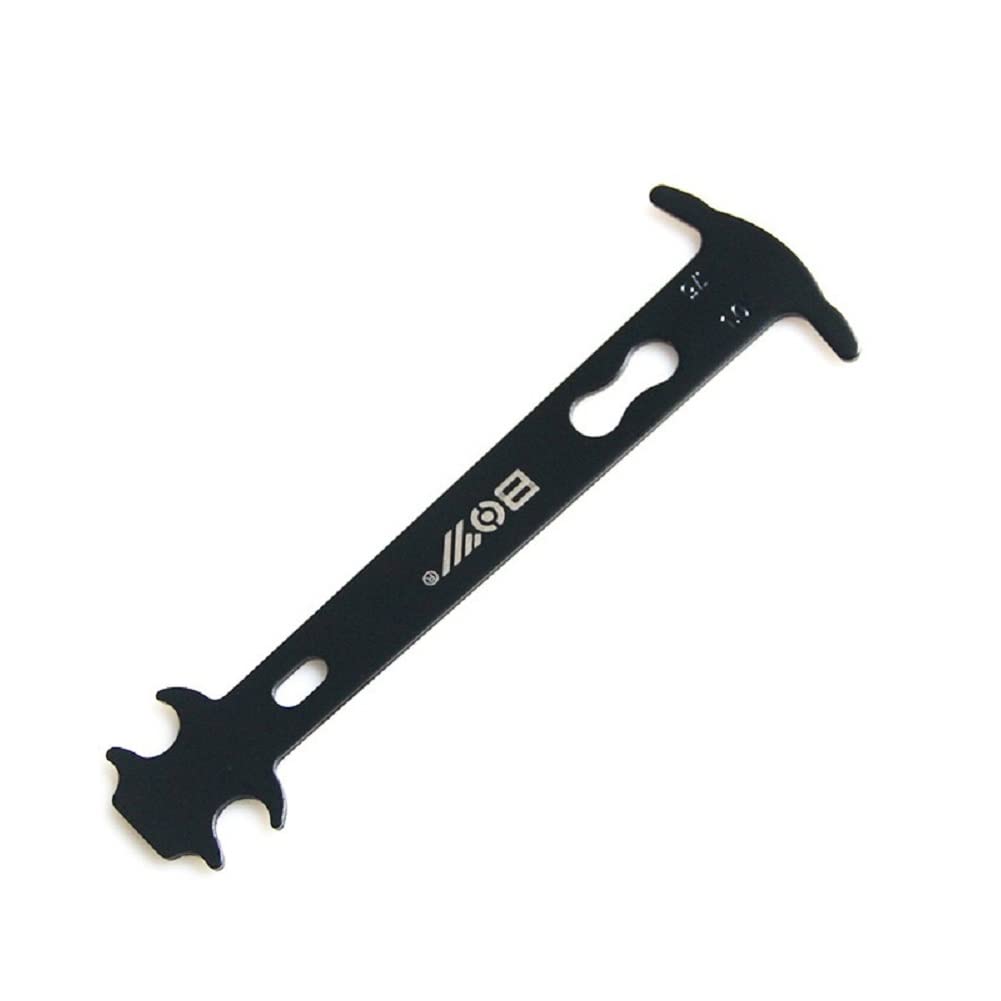
Two gauges here read only 0.75% and 1.0%, and this is the cheaper of them. The Zuoyou is a stamped carbon-steel go/no-go, 140.5 millimeters long, and it does the same job as the BikeHand for less money.

The markings are the weak point. The scale is stamped on a narrow face and the gap between the two readings is a small notch, so you have to hunt for it, and in a dim garage on a dirty chain that is a genuine annoyance. It gets easier with practice, but it never becomes as obvious as the big step on a Park gauge.

As a spare, we see the point. Keep one on a winter commuter, in the car, or in the toolbox you take to a bike you are fixing up, and it is the least money you can spend on a real check. For the bike you actually ride, buy a gauge that reads 0.5% instead.

Bottom line: We treat the Zuoyou as a spare for an older bike: the same 0.75% and 1.0% check as the BikeHand for less, with markings that make you work for the reading.

How We Tested Bike Chain Checkers

We started by gathering every chain checker we could find from the major tool brands alongside a pile of generic stamped-steel gauges, then cut anything that read only a single wear threshold or had a hinge that felt loose right out of the package. That left 14 tools, which we ran for four months on the same set of chains at three known stages: factory new, comfortably inside spec, and worn past the point where replacement was due.

Each checker measured each chain three times, and we cross-checked every reading against a steel ruler and digital calipers. We noted whether the gauge dropped in at the first threshold or needed a shove, whether the pins sat flush against the rollers, and whether the same tool on the same chain gave the same answer an hour later. A checker that disagreed with the ruler got retested before we wrote it off, since a single bad reading could have been my hand and not the tool.

Ease of use got its own pass in the garage: I used each one one-handed on a bike still in the stand, timed how long a clean reading took, and judged the markings by whether I could read them under a single overhead bulb. Several arrived with no instructions or a diagram that assumed you already knew which end went where, so the clock started from zero every time. At the end of the four months we went back over pins and hinges for slop, checked whether the markings had worn off, and decided which of the inexpensive ones had earned a permanent spot in a saddlebag.

How to Choose Bike Chain Checkers

Match the Wear Marks to Your Drivetrain

Wear limits are not universal, and this is the mistake that costs people a cassette. An 11- or 12-speed chain is considered worn at 0.5%, a 5- to 10-speed chain at 0.75%, and a single-speed or a very old setup can run out to 1.0%. A gauge that reads only 0.75% and 1.0% is perfectly good on a nine-speed commuter and useless on a modern road bike: it keeps telling you the chain is fine while the chain quietly reshapes the cogs. Count the speeds on your cassette before you shop, then check the gauge lists that number.

The picks separate cleanly here. The two Park gauges, the Pedro's and the KIEVODE read 0.5% and 0.75%. The BikeHand and the Zuoyou stop at 0.75%, which makes them budget tools for older drivetrains rather than all-rounders.

Two Pins or Three? What the Gauge Is Measuring

A two-pin go/no-go drops a pair of prongs into the chain and lets the body give the answer: sits flat, keep riding; drops in, replace. It is fast and hard to misread. A three-point design adds a third contact so the reading follows pin wear rather than slop in the rollers. On a gritty, dry-run chain the difference shows up, because a two-pin gauge can call a chain finished while there is still life in the pins.

For most home mechanics the simpler tool is accurate enough, and the money is better spent on a gauge with the right marks. If you are chasing a drivetrain that seems to eat chains, the three-point reading is the second opinion worth having.

Get a Reading You Can Trust

The pins are the precision, and on a metal gauge they are two thin prongs that bend if the tool lives loose in a toolbox next to a chain whip. A bent pin makes a good gauge lie, so keep it in a sleeve or a dedicated pocket. When you check, hold the body square to the chain instead of rocking it in by hand, and take a reading in two or three places around the loop. Chains wear unevenly, and one dry or stiff link can give an answer that does not hold anywhere else.

Check with the chain on the bike under normal derailleur tension, and wipe it first. A slack, filthy chain is harder to read and harder on the tool.

What to Spend, and What It Protects

Every gauge here costs a fraction of the cassette and chainrings a worn chain destroys, which is the argument for owning one at all. Beyond that you are paying for convenience rather than accuracy: a chain hook and chainring nut wrench on the Pedro's, a lifetime warranty and a name every shop knows on the Park tools, printed replacement guidance on the KIEVODE, or the smallest possible outlay on the BikeHand and Zuoyou. Buy for the bike you actually ride and the jobs you actually do, and the choice gets simple.

Frequently Asked Questions

Final Verdict

Buy the Park Tool CC-4. It reads the two marks that cover every derailleur chain from 5- to 12-speed, including the SRAM AXS chains a lot of cheap gauges skip, and it gives you an answer in one glance with a metal body that has nothing to adjust.

If your bikes are 10-speed or older and you want to spend as little as possible, the CC-3.2 does the same job for less. If you ride SRAM Eagle and swap chains often enough to want a chain holder in your hand, the Pedro's three-point reading and built-in hook are worth the step up.