Tires & Tubes

8 Best Bike Tire Pressure Gauge of 2026: Gauges That Fit Your Valves and PSI Range

Find a bike tire pressure gauge that actually covers your PSI range and fits Schrader or Presta valves without guesswork.

Most tire pressure gauges are built for cars and trucks. They top out at 60 or 75 PSI and assume a Schrader valve with no adapter needed. If you ride a road bike, those gauges stop being useful before your tires even hit the recommended pressure.

A bike-specific gauge needs to reach at least 100 PSI, fit Presta valves (or include an adapter), and hold a reading without air leaking past the seal. Cheap pencil gauges can work if the range is right, but digital options offer better precision for the same money.

This guide focuses on gauges that actually match your bike's pressure needs and valve type. No automotive hand-me-downs — just tools that give you a reliable number you can trust before a ride.

1

ETENWOLF Pencil 2 Pack

Top Pick
ETENWOLF Pencil 2 Pack

Simple analog gauge

Our Score 9.4/10
Check Price

Worth Noting

  • Analog scale can be hard to read precisely, and some units may read a few PSI off from each other.
Accuracy
Not specified
Readability
Mechanical scale
Build Material
Stainless steel
Pressure Range
10-50 / 20-120 PSI
Read the full review

The ETENWOLF two-pack delivers all-metal pencil gauges for both low and high bicycle tire pressures, making it a practical choice for cyclists with multiple bikes. The analog readout is less precise than a digital gauge, and individual units may show slight variance — acceptable for routine checks but not for exact tuning. Best suited for riders who want a cheap, no-fuss tool for quick pressure adjustments.

Check both gauges against a known reference to account for any unit-to-unit variance.

Bottom line: A no-nonsense analog gauge set for cyclists who prioritize simplicity and low cost over digital precision.
2

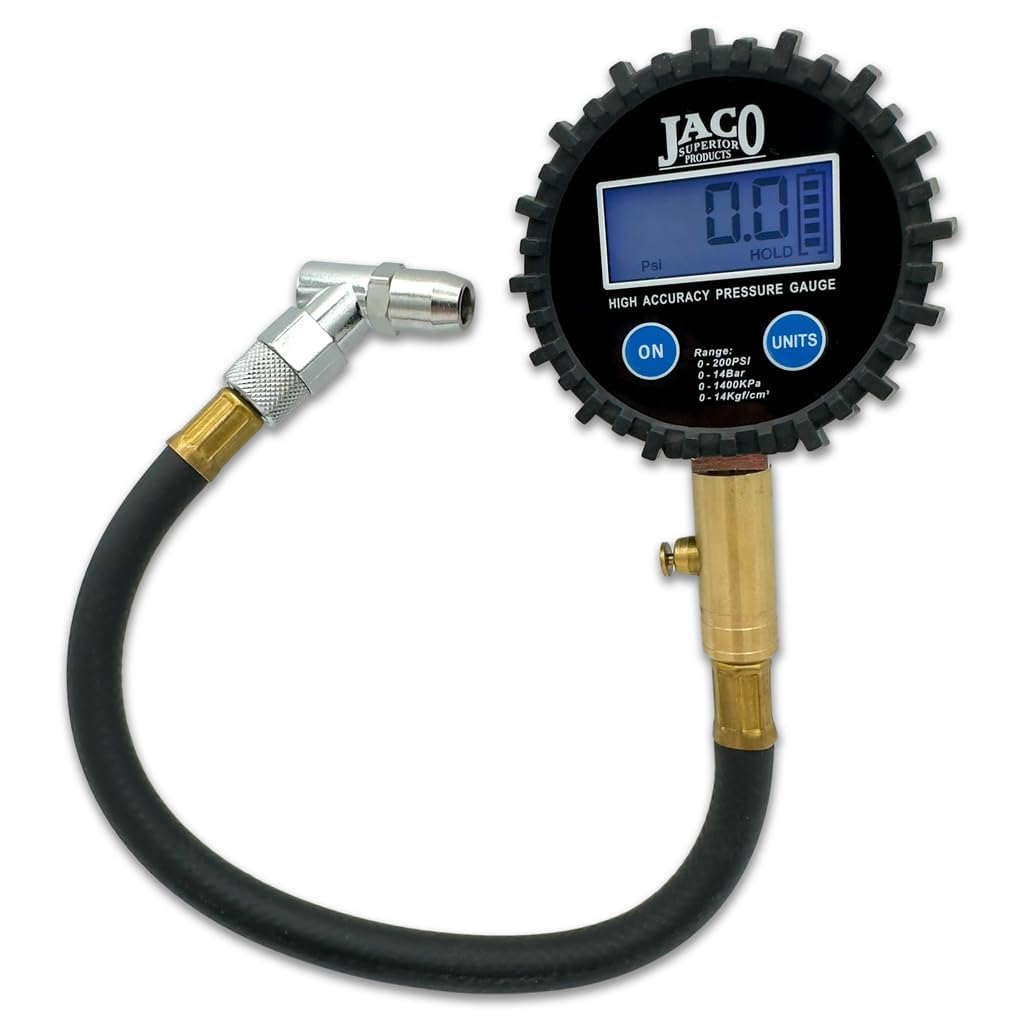
JACO ElitePro Digital

JACO ElitePro Digital

Precision gauge

Our Score 9.4/10
Check Price

Worth Noting

  • Premium pricing; occasional unit-to-unit variance with bleeder valve or accuracy.
Accuracy
±0.5% FS
Readability
Backlit LCD
Build Material
Solid brass, rubber guard
Pressure Range
Up to 200 PSI
Read the full review

The JACO ElitePro delivers ±0.5% FS accuracy and a solid brass construction backed by a lifetime warranty — a step up in build from the budget-oriented top pick. The swivel hose and bleeder valve make seat adjustments intuitive, and the backlit LCD works well in dim garages.

This gauge is best suited for enthusiasts who demand precision and durability and are willing to pay a premium. The price is higher than most bicycle-focused gauges, and some units have shown accuracy or bleeder inconsistencies — so verifying function on arrival is prudent.

Upon receiving the gauge, check accuracy against a known reference and cycle the bleeder valve a few times to confirm smooth operation.

Bottom line: A professional-grade tool for cyclists who prioritize accuracy and build quality; just account for the premium price and test the unit upon receipt.

3

ETENWOLF T300 Digital

ETENWOLF T300 Digital

All cyclists

Our Score 9.2/10
Check Price

Worth Noting

Accuracy
±1 PSI
Readability
Backlit LCD + LED
Build Material
ABS plastic, brass
Pressure Range
3-200 PSI
Read the full review

The ETENWOLF T300 digital tire pressure gauge covers a 3-200 PSI range with ±1 PSI accuracy, suitable for mountain bike tires, road bike tires, and car tires. The backlit display and LED nozzle light ensure clear readings in any lighting condition. It reads in PSI, BAR, KPA, and Kg/cm², and auto-off saves battery. The replaceable AAA batteries mean you can keep it running for years without searching for a charging cable.

This gauge fits cyclists who want an affordable digital tool with consistent accuracy and wide range. The only missing piece is a Presta valve adapter — road cyclists with Presta valves will need to pick one up separately (they cost a few dollars and are easy to find). For everyone running Schrader valves, it works straight out of the box. The seal requires a centered placement on the valve stem to avoid air leakage, but with a little practice it becomes routine.

Bottom line: The T300 is the digital gauge to grab if you want accurate, wide-range readings without paying extra for batteries or features you won't use — just add a Presta adapter if needed.

4

AstroAI Heavy Duty

AstroAI Heavy Duty

High-pressure users

Our Score 9.2/10
Check Price

Worth Noting

  • Joint between steel shaft and plastic case may snap under lateral stress over time
Accuracy
±0.5%
Readability
Backlit LCD + flashlight
Build Material
Stainless steel, plastic
Pressure Range
0-230 PSI
Read the full review

Its wide range and digital precision work for any tire, but the bulky design and the joint between steel shaft and plastic case can snap under stress — overkill for everyday bike use, better suited as a dual-purpose gauge for someone who also airs up RV or truck tires.

Bottom line: Fits best if you need a single gauge for both bike and high-pressure vehicle tires, and are willing to handle the extra bulk and possible stress at the shaft joint.

5

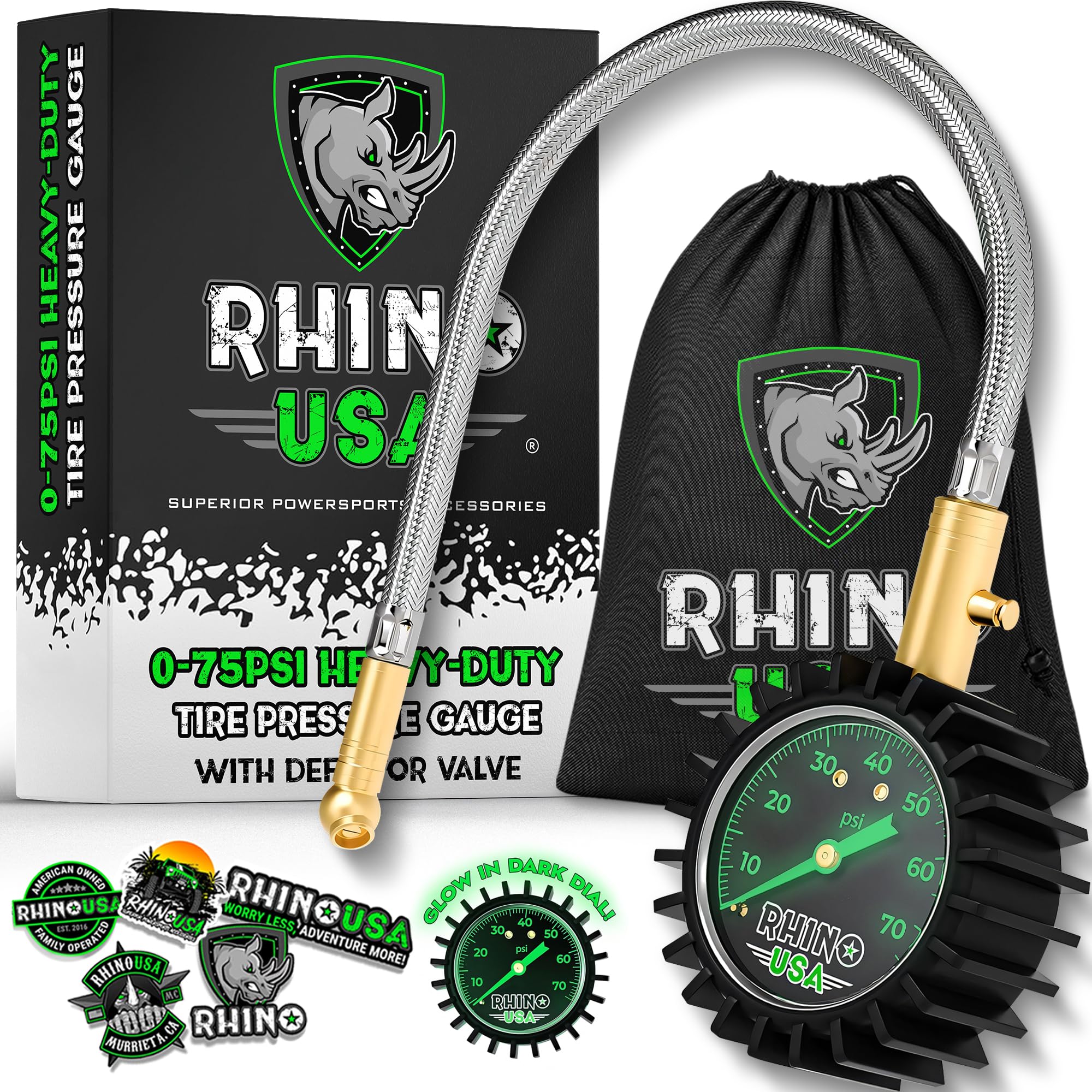
Rhino USA Dial 75

Rhino USA Dial 75

Low-medium pressure

Our Score 9.2/10
Check Price

Worth Noting

  • Maximum 75 PSI range insufficient for road bike tires.
Accuracy
ANSI B40.1
Readability
Glow dial
Build Material
Solid brass, braided hose
Pressure Range
0-75 PSI
Read the full review

This gauge's brass body and braided hose feel durable, with a glow dial for dim light. ANSI B40.1 accuracy and lifetime warranty make it a reliable choice for mountain bike pressures up to 75 PSI. That ceiling excludes road cyclists needing higher pressure.

Bottom line: Best for mountain bikers and off-roaders who stay within 75 PSI; not a fit for road cyclists.

6

JACO ElitePro 100

JACO ElitePro 100

Up to 100 PSI

Our Score 9.0/10
Check Price

Worth Noting

  • Valve stem end may break after limited use; not for pressures above 100 PSI
Accuracy
±1.5% ANSI
Readability
Glow dial
Build Material
Solid brass, rubber guard
Pressure Range
Up to 100 PSI
Read the full review

The JACO ElitePro 100 offers a premium analog feel with its solid brass build and flexible hose, accurate to ±1.5% for tires up to 100 PSI. However, the range falls short for road cyclists needing 120 PSI, and some units have experienced valve stem breakage after limited use — a risk worth checking before buying.

Bottom line: A well-made analog gauge for truck/SUV owners or road cyclists riding under 100 PSI, but the risk of valve stem failure and the 100 PSI ceiling make it a cautious pick for high-pressure road bikes.

7

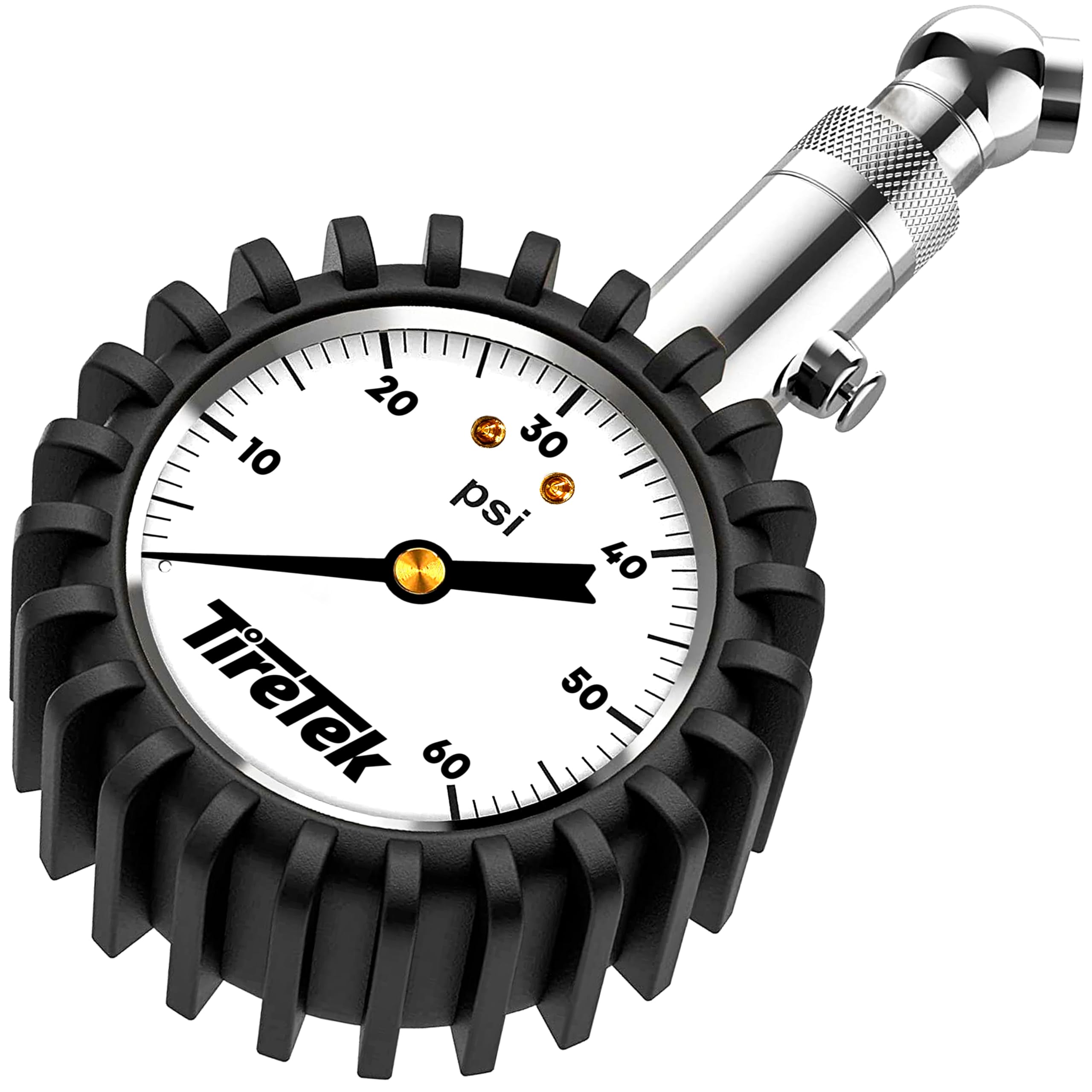
TIRETEK Dial

TIRETEK Dial

Car/low-pressure

Our Score 9.0/10
Check Price

Worth Noting

  • Limited to roughly 60 PSI
Accuracy
±2% ANSI Grade B
Readability
Large glow dial
Build Material
Steel, brass, rubber
Pressure Range
0-60 PSI
Read the full review

This analog gauge delivers a clear reading and solid grip for car pressures, and its swivel chuck makes reaching awkward valve stems simple. The catch for cyclists: the range tops out around 60 PSI, so road bike tires at 80–120 PSI are out of reach. Occasional low-pressure bike checks (e.g., mountain bike or car tires) are fine, but buyers needing regular bicycle compatibility should look at higher-range options.

Bottom line: A capable budget gauge for car owners who occasionally check low-pressure bike tires, but not a fit for road cyclists needing higher PSI.

8

AstroAI Digital 150

AstroAI Digital 150

Budget digital gauge

Our Score 8.8/10
Check Price

Worth Noting

  • Individual unit accuracy can vary
Accuracy
±1 PSI
Readability
Backlit LCD + nozzle light
Build Material
Plastic, rubber
Pressure Range
0-150 PSI
Read the full review

The AstroAI is the most popular digital gauge on Amazon, pairing a bright backlit display and nozzle light with a budget-friendly price. It suits cyclists who need quick pressure checks for road or mountain bike tires (20-120 PSI is comfortably within its 0-150 range). The simple press-on operation and replaceable LR44 batteries add everyday convenience. However, unit-to-unit accuracy can vary – a small number may read a couple PSI off, so cross-checking with a reference gauge is wise for those who require tight precision.

Bottom line: For cyclists on a tight budget who do not need lab-grade precision, the AstroAI delivers strong value with a bright display and straightforward operation.

How to Choose

Pressure Range

Road bike tires typically run 80-120 PSI, while mountain bikes sit around 30-50 PSI. A gauge that tops out at 60 or 75 PSI is useless for road riding. Look for a gauge that reaches at least 100 PSI — ideally 120 PSI or more — so you have headroom for different bikes.

If you only ride low-pressure tires (MTB, cruiser, kids bikes), a 0-75 PSI gauge is sufficient and often cheaper. The trade-off is that you can't use it on a road bike later.

Accuracy

Most digital gauges claim ±1 PSI accuracy, which is good enough for consistent tire pressure. Analog gauges and pencil gauges are typically ±1.5-2% of full scale, meaning they can be off by 1-2 PSI at road bike pressures.

That difference matters for handling and rolling resistance. If you're a competitive rider or run very narrow tolerances, a digital gauge with ±0.5% FS (like the JACO ElitePro) gives you repeatable results. For casual checks, ±1 PSI is fine.

Valve Compatibility

Bikes use Schrader (same as cars) or Presta (narrower, with a locknut). Most gauges sold for cars are Schrader-only. If you have Presta valves, you need a gauge that includes a Presta adapter or has a reversible head.

A separate adapter is cheap and fits in a saddle bag. The mistake is assuming the gauge works out of the box — always check the listing for 'Presta compatible' or buy a $2 adapter alongside the gauge.

Readability

Digital backlit screens are easy to read in dim light or at night. Analog glow dials accumulate light during the day and glow for a few hours. Pencil gauges have no illumination and rely on ambient light.

If you often pump tires in a garage or after dark, a backlit digital gauge or a glow dial analog gauge is much more convenient. Pencil gauges are fine for daylight checks or as a backup.

Durability and Build Materials

Digital gauges with plastic bodies can crack if dropped, while solid brass or stainless steel construction withstands shop floors. Rubber guards add grip and impact protection.

Gauges used in a home garage see less abuse than those carried on rides. For portability, a pencil gauge or compact digital is lighter. For heavy daily use, a brass-body gauge with a lifetime warranty is worth the premium.

Frequently Asked Questions