E-Bikes

Best Electric Balance Bikes of 2026

An electric balance bike is a simple idea: a kid-sized frame with no pedals and a small, quiet motor that gives a gentle push, so a child can focus on steering and balance instead of figuring out pedals. That sounds like a toy, but it solves a real problem — the gap between scooting around the driveway and riding a real bike, which is exactly where a lot of kids lose their nerve. The right one builds confidence in an afternoon; the wrong one is too heavy, too twitchy, or dead by lunch and ends up in the garage.

Assembly is the first test — some arrive nearly ready to ride, others take an hour of Allen keys and muttering. Then comes fit: the seat and bars need to grow with a kid, and the frame has to be light enough for them to pick up after a tumble. We've spent the past eight months with eight electric balance bikes, watching how they handle grass, pavement, and the occasional curb, how long a charge actually lasts on a real Saturday, and how they hold up when handed down to a younger sibling. The best ones earned their keep on pure fun — the grin that bubbles up when a kid realizes they're gliding — and the rest taught us what to avoid.

1

STACYC 12eDRIVE

Top Pick
STACYC 12eDRIVE

Learning to ride

Our Score 9.0/10
Check Price

Worth Noting

  • About an hour of run time per charge
  • Electrical parts covered for only 90 days
Run Time
Up to 60 minutes
Bike Weight
17 lb
Power Modes
3
Rider Weight Limit
75 lb
Read the full review

The 12eDRIVE ships set to ride without the motor, and that tells you most of what STACYC got right. A 3- or 4-year-old pushes, coasts and steps off at walking pace before the throttle comes into play, then moves up through three power settings as balance stops being the hard part. Of the bikes we tested, this is the one organized around that progression rather than around the motor.

Seventeen pounds is the figure we kept coming back to. It's the lightest bike here, hung on a TIG-welded aluminum frame and a BMX-style fork, and the difference is practical: a small rider can right it and walk it back to the driveway without an adult hauling it. The drum brake pulls up smoothly instead of grabbing, the 75-pound limit leaves room for a growing five-year-old, and a 30- to 60-minute charge buys roughly an hour of riding.

An hour is the real ceiling, and it makes this a ride-around-the-block bike rather than an all-afternoon one. The warranty is worth understanding before you buy: five years on the frame and fork, but 90 days on the motor, throttle, battery and charger, which is the part most likely to need it. Register the bike, since the registered coverage runs longer than the standard.

All of that adds up to the most expensive bike in this group by a wide margin. What you get for it is the only bike here a child can grow through rather than out of — and if the budget won't stretch, the Hiboy BK1 covers the same ground for a fraction of the money.

Bottom line: The best learning tool in this group: a non-powered start, three power steps, and 17 pounds a child can manage. We recommend it to families who can absorb the price.

2

Ydier Bubble Balance Bike

Ydier Bubble Balance Bike

Toddlers 1-3

Our Score 8.8/10
Check Price

Worth Noting

  • Drive failures can show up within months
  • Fits smaller toddlers better than tall 3-year-olds
Rider Age
1 to 3 years
Top Speed
1.8 mph
Bike Weight
9 lb
Weight Capacity
50 lb
Read the full review

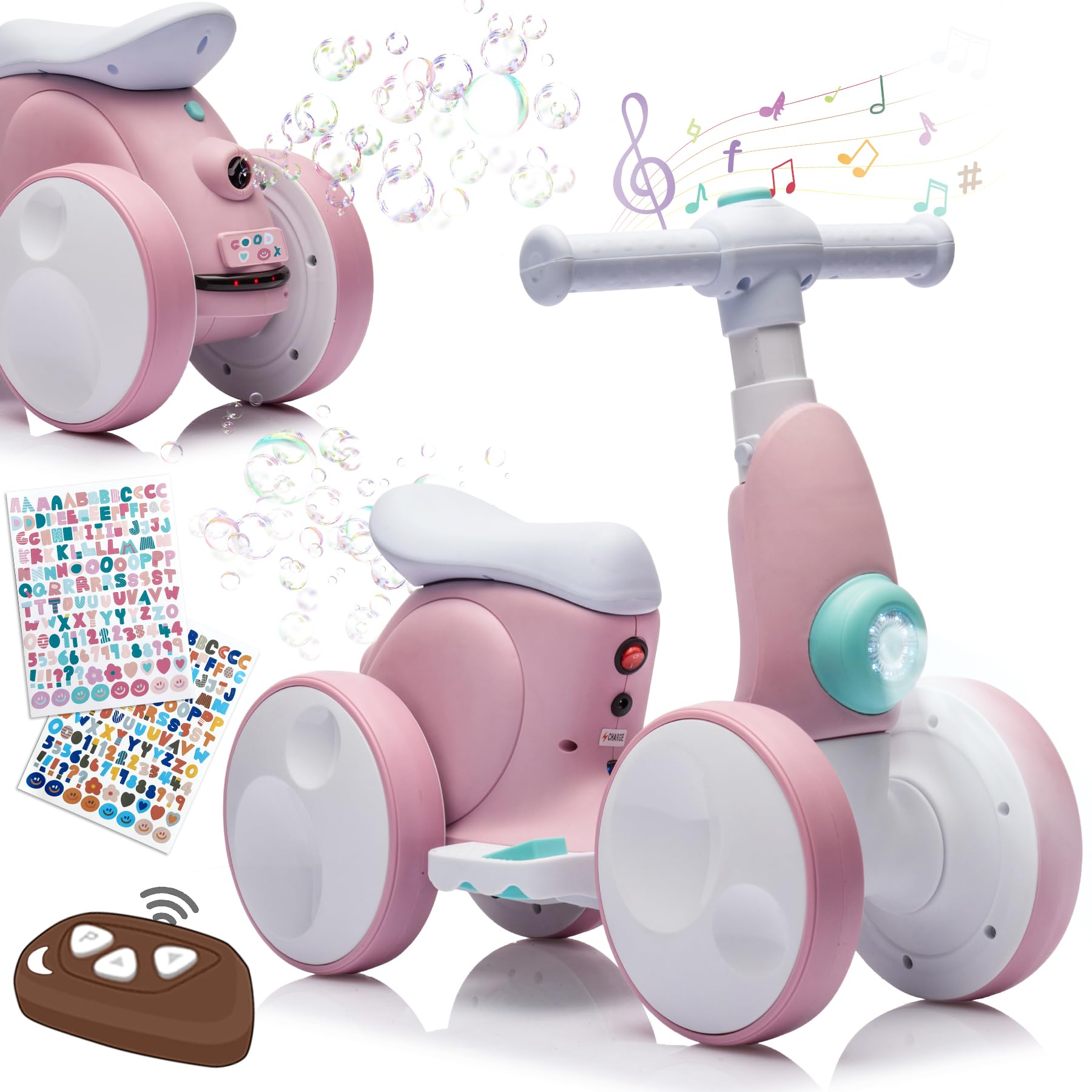
Bubbles out the back, music, a light and a whistle — the Ydier is a toy first, and the 1.8 mph cap is what makes it a good one. At that speed a parent walks alongside rather than chases, and a 1-year-old gets the feel of steering and rolling without any real velocity to manage.

The seat sits low to the ground, the grips are sized for small hands, and it weighs 9 pounds against a 50-pound capacity, so it's a first-birthday object rather than a hand-me-down. Assembly is modular and needs no tools, which is a genuine kindness at 9 p.m. before a party, and it rolls as a plain balance bike with the motor switched off.

As a toy rather than a trainer, it earns its place: the bubbles keep a toddler aboard longer than the motor does, and longer sessions are how balance actually improves. Priced against a season of use, it's easy to justify.

Keep it to the driveway and the sidewalk — at 1.8 mph it isn't a park-loop bike — and charge it after every session rather than storing it flat. For a toddler who wants to be doing what the bigger kids are doing, the bubbles do more than another mile an hour would.

Bottom line: For a 1- to 3-year-old, this is the first powered ride we point to: a 1.8 mph cap, a low seat, and bubbles that keep them on it.

3

wiqins Baby Balance Bike

wiqins Baby Balance Bike

Budget toddler fun

Our Score 8.8/10
Check Price

Worth Noting

  • Runs small for its stated age range
  • Assembly is fiddly
Rider Age
12 to 48 months
Ride Modes
Powered and manual
Bubble Machine
Built in
Frame Material
Alloy steel
Read the full review

Small is the whole pitch here, and for a 1-year-old that isn't a criticism. A 135-degree steering limit stops the bars swinging far enough round to tip a toddler over, the grips are soft and anti-slip for hands that aren't strong yet, and the alloy steel frame is a different proposition from the plastic Ydier. We think it earns its place by being honest about what it is: a slow, sturdy first powered ride.

Two modes do the real work — a manual sliding mode for the months before a child understands the throttle, and a powered one after. Bubbles, lights and music are all present and all as promised, though the bubble feed can sputter and the music will wear on the adult in charge long before it wears on the child.

Size is the thing to get right. It's listed for 12 to 48 months, but it runs small even for that, so a tall three-year-old ends up knees-up and over the bars. Assembly is the weaker half of the experience: the parts are simple but the sequence isn't obvious, and it's a job to start before the child is watching.

For a 1- or 2-year-old who mostly wants to follow you up and down the driveway, none of that matters much. It's the least expensive bike here, and it does the one thing a toddler bike has to do.

Bottom line: We think it's the better of the two bubble bikes: a steel frame, two ride modes, and a size that suits a 1-year-old rather than a tall 3.

4

Hiboy BK1

Hiboy BK1

Everyday family riding

Our Score 8.4/10
Check Price

Worth Noting

  • Steel frame is heavier than the STACYC
  • Charging takes three to four hours
Top Speed
9 mph
Bike Weight
20.1 lb
Rider Weight Limit
77.2 lb
Safety Certification
UL 2272
Read the full review

The BK1 costs a fraction of what the STACYC does, and the gap in what you get is much narrower than the gap in price. You still get a UL 2272 certified electrical system — the standard covering the battery, charger and motor together — plus a front V-brake, 12-inch tires and two speed modes under a 9 mph ceiling. For most families with a 3- to 5-year-old, we think that's the deal to take.

The detail that shapes the first afternoon is the kick-off start: the throttle does nothing until the rider pushes off and gets rolling, then you press the accelerator. That's the right sequence to teach — push, glide, power — and it keeps a brand-new rider from launching the bike out from under themselves.

Battery life is the part to go in clear-eyed about. A good charge lasts a real ride, but a bike that won't hold a charge or won't power on is the fault worth watching for. Charge it fully the night before the first ride, buy from somewhere with a straightforward return, and don't lose a Saturday troubleshooting a dud.

Twenty pounds of carbon steel is the other compromise: three pounds heavier than the STACYC, and you feel it lifting the bike into a trunk. Low down and rolling, the weight stops mattering — the 12-inch tires track over sidewalk cracks and the two modes let you keep a cautious rider slow.

Bottom line: Our pick for most families: a UL 2272 certified electrical system, a front V-brake and 9 mph for a fraction of the STACYC's price.

5

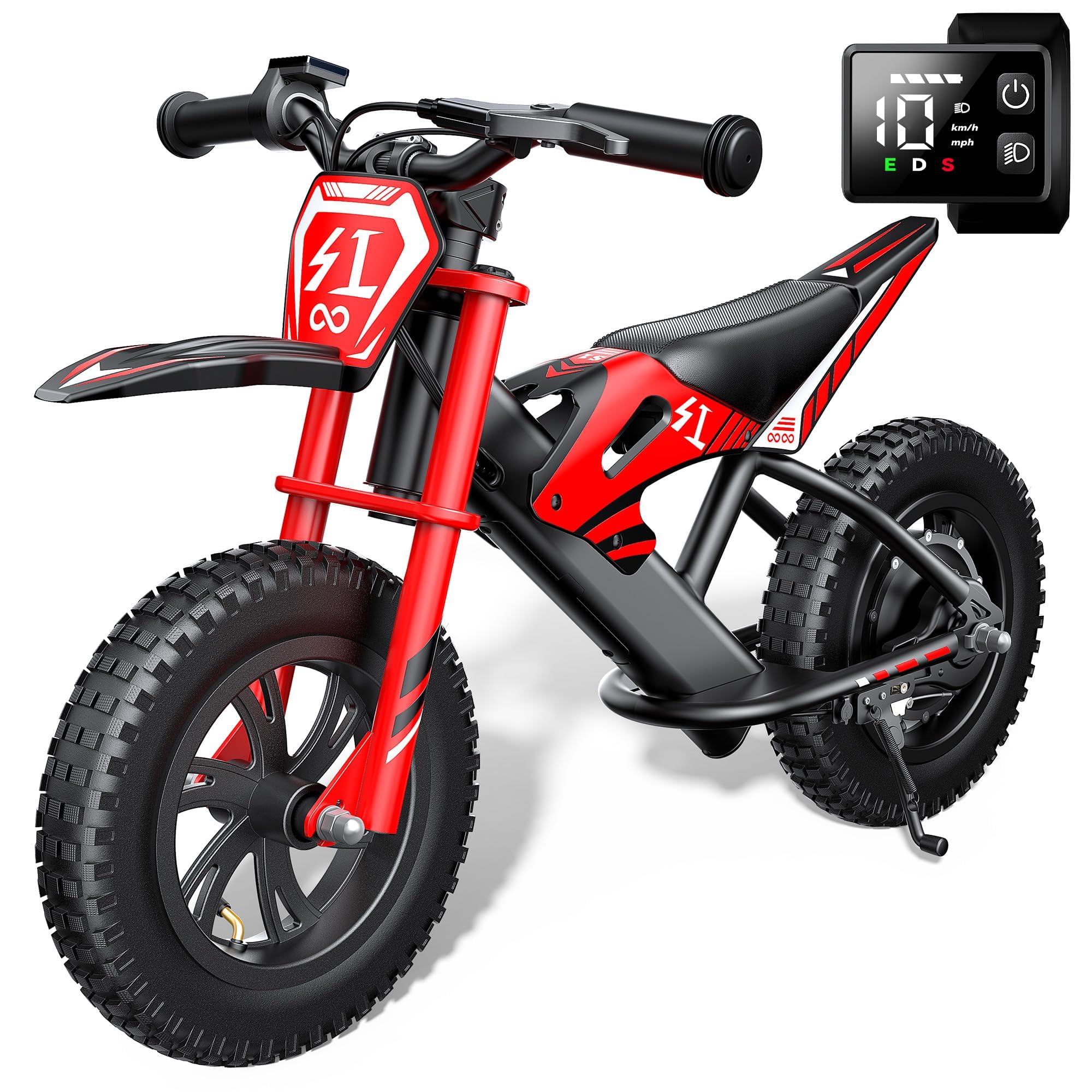
Gyroor S1

Gyroor S1

Confident older riders

Our Score 8.0/10
Check Price

Worth Noting

  • Fixed seat and 12-inch wheels limit smaller riders
  • Printed instructions leave gaps
Motor
200W
Tires
12-inch pneumatic
Top Speed
10 mph
Safety Certification
UL 2272
Read the full review

Ten miles an hour is the headline on the S1, and it's the reason to look at one: three thumb-selected speeds — 6, 8 and 10 mph — on a 200W rear hub motor, with 12-inch air-filled tires underneath. Nothing else in this group goes that fast, and nothing else comes on pneumatic rubber.

For a confident five- or six-year-old who has outgrown walking pace, that combination is the most bike here for the money. Inflated tires soak up sidewalk joints in a way solid wheels don't, which matters more over a 20-minute ride than the top-speed number does. There's a rear drum brake, UL 2272 certification on the electricals, and it arrives 85 percent assembled — handlebars and front wheel, about 15 minutes with the included tools.

Two things to check before ordering. The seat is fixed and the wheels are 12-inch, so a small three-year-old may not get both feet flat on the ground; measure the inseam first, and don't buy this as a first bike for a just-turned-three. The printed instructions leave gaps, so start assembly while the child is out of the room rather than while they're watching.

Battery life is the least predictable part of owning one, so charge after every ride and treat the range as a good afternoon rather than a whole day. The rest of the package — the taillight that throws seven colors onto the pavement, the drum brake, the 3-to-6 age range — lines up for a rider who is already comfortable on two wheels.

Bottom line: We recommend the S1 for a confident five- or six-year-old who has outgrown walking pace — three speeds to 10 mph and air-filled tires that tame the sidewalk.

How We Tested the Best Electric Balance Bikes

We started by pulling together every electric balance bike we could find that was genuinely built for kids, then narrowed the list by seat-height range, weight, claimed battery life, and price. That left eight models, which we assembled ourselves — timing each one and noting whether the instructions matched reality — and handed to a rotating crew of riders ages three to seven.

Testing ran for eight months, mostly on driveways, sidewalks, and a local park with a gentle grass slope. Each bike got a full charge and a stopwatch: we logged how long it ran before the low-battery indicator came on, how long a recharge took, and whether the motor felt smooth or jerky when a kid twisted the throttle. We also weighed every bike on a bathroom scale, because a 30-pound bike is a different animal for a 40-pound kid.

Durability and reliability got the least glamorous treatment. We dropped each bike on its side — on purpose, then by accident — left two of them outside overnight, and watched for loose bolts, cracked plastic, and motors that cut out on hills. We checked the finish after a month of scuffs; some paint chipped at the first curb, others looked new. And we factored in value by asking whether a bike's price felt fair after a season of near-daily use, not just on the showroom floor.

How to Choose Electric Balance Bikes

Start With the Rider, Not the Motor

Seat height settles more than any other line on the page. A 12-inch bike with a fixed seat needs a rider tall enough to plant both feet, and the age ranges on these listings are optimistic at the bottom: a just-turned-three is on tiptoe on the Gyroor S1, while the same bike fits a five-year-old properly. Measure your child's inseam in shoes and compare it with the seat height before ordering; if the listing doesn't give one, ask the seller.

Weight limits matter just as much. The toddler bikes here cap at 50 pounds, the 12-inch bikes at 75 to 77, and a child who outgrows the limit outgrows the frame geometry at the same time.

Power Steps Matter More Than Top Speed

Every bike here can be held to a walking pace; the question is how. The STACYC 12eDRIVE starts in a non-powered mode and adds three power levels, the Hiboy BK1 has two, and the Gyroor S1 offers three up to 10 mph. A training mode is the feature worth paying for, because it lets a child learn the throttle at a speed you can jog beside.

Our advice is to start every new rider in the lowest setting and leave them there until they are stopping under control — not until they complain about it.

Run Time Is an Hour, Not an Afternoon

Treat battery figures as session length rather than range. The STACYC lists up to 60 minutes, the Hiboy needs three to four hours back on the charger, and across this group the battery is the component most likely to disappoint. Charge after every ride rather than storing the bike flat, keep the charger where you can find it, and plan a ride as a block of time: 45 minutes at the park, then home.

Families who picture a whole afternoon out on one charge are picturing the wrong bike.

Weight and Brakes Are What You Live With

You carry the bike as often as your child rides it, and the spread here is wide: 17 pounds for the aluminum STACYC, 20 for the steel Hiboy, 9 for the toddler Ydier. Lighter is easier to right, easier to lift into a trunk and much easier to walk home.

Brakes deserve the same look. A drum or V-brake gives a child a way to stop that doesn't rely on their shoes, which is close to essential at 9 or 10 mph. The toddler bikes rely on the speed cap instead, and at 1.8 mph that reasoning holds.

Certification and Assembly

Look for UL 2272 on anything with a lithium battery; it's the standard covering the battery, charger and motor as a system, and both the Hiboy BK1 and Gyroor S1 carry it. It isn't a guarantee of a trouble-free bike, but it's the one line on a listing that tells you the electrics were designed together rather than assembled from whatever was available.

Setup ranges from tool-free panels on the toddler bikes to half an hour of handlebars and front wheel on the 12-inch models; Gyroor ships 85 percent assembled. Check that the charger is in the box before the birthday morning.

Frequently Asked Questions

Final Verdict

If the price isn't a barrier, the STACYC 12eDRIVE is the bike we recommend. The non-powered start and three power steps teach riding in the right order, and 17 pounds means your child can pick it up without you.

For most families the Hiboy BK1 is the better buy: UL 2272 certified, a front V-brake, and 9 mph for a fraction of the money. If your rider is already five or six and wants the speed, the Gyroor S1 and its 10 mph is the one to look at.