Tools & Maintenance

10 Best Mountain Bike Shock Pump of 2026: Get Accurate Pressure Every Time

Find a shock pump that delivers accurate pressure without losing air when you disconnect – pick the right one for your suspension setup.

Every mountain biker knows the frustration: you pump your fork to the exact number, disconnect the pump, and the gauge drops 5 PSI. That air loss isn't a defect - it's a built-in trade-off of analog shock pumps caused by the Schrader valve core.

But some pumps handle this better than others. A well-designed valve head and a precise bleeder valve can cut the loss in half, while a digital display removes the guesswork entirely. This guide focuses on the models that give you the most consistent results, ride after ride.

1

RockShox 300 PSI Pump

Top Pick
RockShox 300 PSI Pump

Everyday reliability

Our Score 9.4/10
Check Price

Worth Noting

  • Analog gauge can read 5–10 PSI off, so reaching the exact target pressure may require over-inflation
Material
Max Pressure
300 PSI
Bleeder Valve
Yes
Read the full review

The RockShox shock pump brings a metal connector and solid construction that feel substantial in hand. Feedback from thousands of rides shows it handles repeated high-pressure use without issue, making it a common sight in mountain bike packs and workshops alike.

Air delivery is efficient, and the integrated bleeder valve lets you fine-tune pressure on the trail. The analog gauge behaves like most at this price point – it can read 5–10 PSI off, so many riders compensate by over-inflating slightly and then bleeding down to their target.

This pump fits the typical mountain biker who runs RockShox or Fox air forks and a rear shock and wants a straightforward tool that works ride after ride. It is not designed for digital precision or pressures above 300 PSI (such as IFP reservoir tuning) – those uses call for a digital pump or a higher-pressure model.

Compensate for gauge deviation by inflating 5–10 PSI beyond your target and using the bleeder valve to dial it back down.

Bottom line: A straightforward, well-built pump for routine suspension adjustments – the gauge variance is a minor tradeoff given the track record and broad compatibility.

2

Fox HP 350 Pump

Fox HP 350 Pump

Portable swivel head

Our Score 9.4/10
Check Price

Worth Noting

  • Effort to reach high pressures can be significant above 200 PSI
  • Some air loss occurs when disconnecting the pump
Material
Stainless steel / 6063 aluminum
Max Pressure
350 PSI
Bleeder Valve
Yes
Read the full review

The Fox HP pump’s swivel head reaches awkward shock valve positions without bending the hose, and its micro-bleeder lets you fine-tune pressure in small increments. This makes it the more trail-friendly option compared to older Fox pumps with fixed heads.

The all-metal construction feels premium and well-machined, while the compact size slides easily into a hydration pack or jersey pocket. These details make it a natural companion for riders who adjust suspension on the go.

Riders who value portability and a compact tool for on-trail adjustments will appreciate the Fox HP. However, pumping above 200 PSI takes more effort, and some pressure loss on disconnect is typical for analog pumps. This pump suits those who prioritize convenience over high-pressure ease.

For shocks requiring pressures above 200 PSI, pump in short bursts and expect a few PSI loss when disconnecting.

Bottom line: Best for riders who need a portable pump for typical trail-side adjustments and don't regularly exceed 200 PSI.

3

RockShox Digital 300

RockShox Digital 300

Precision tuning

Our Score 9.4/10
Check Price

Worth Noting

  • At roughly twice the cost of a capable analog pump, the upfront investment is higher.
  • On rough trail rides, the digital display may be more vulnerable to impacts than a mechanical gauge.
Material
Max Pressure
300 PSI
Bleeder Valve
Read the full review

The RockShox Digital 300 delivers exact pressure readings in 0.5 PSI increments, a level of precision that analog pumps can't match without over-inflation guesswork. This digital accuracy sets it apart from the classic RockShox analog pump, which requires users to inflate a few PSI above target to account for gauge variance.

This pump suits riders who want repeatable suspension settings for every ride – competitive cyclists and weight-weenies fine-tuning sag, rebound, and bottom-out resistance. The tradeoff is a premium price, roughly double a good analog pump, and a digital display that's inherently less rugged than a simple dial in rough trail conditions. If absolute durability under trail abuse is the priority, the mechanical version is a better fit.

Store the pump in a padded bag or glove box to protect the digital display during transport or rough trail days.

Bottom line: Right for riders who want exact, repeatable pressures and are willing to pay a premium for digital precision over the ruggedness of an analog dial.

4

RockShox 600 PSI Pump

RockShox 600 PSI Pump

High pressure specialist

Our Score 9.4/10
Check Price

Worth Noting

  • Gauge is small and marked in 5 PSI increments, making accurate readings difficult.
Material
Max Pressure
600 PSI
Bleeder Valve
Yes
Read the full review

This pump delivers 600 PSI reliably for high-pressure IFP and rear shock reservoir tuning, with a sturdy build that holds up to repeated use. However, the gauge is small and marked in 5 PSI increments, making precise readings difficult. It's best reserved for specialized high-pressure tasks rather than everyday fork tuning.

Bottom line: A good choice for riders who need to set IFP pressures above 300 PSI and can tolerate the gauge's imprecision.

5

Fox 350 PSI Pump

Fox 350 PSI Pump

Fox suspension users

Our Score 9.2/10
Check Price

Worth Noting

  • Air loss on disconnect may require over-inflating by a few PSI
  • Gauge cover can detach in certain units
Material
Aluminum
Max Pressure
350 PSI
Bleeder Valve
Yes
Read the full review

This Fox pump works effectively across Fox and RockShox forks and shocks, with a smooth pumping action and metal construction that feels durable. However, it's an older design; the newer Fox HP pump offers a more compact swivel head and fewer air loss complaints. The gauge cover can detach in some units, and pressure loss on disconnect is a known tradeoff typical of analog pumps.

Bottom line: A reasonable backup pump for Fox owners who prefer brand consistency, as long as you accept the air loss during disconnect.

6

GIYO 300 PSI Pump

GIYO 300 PSI Pump

Budget no-air-loss

Our Score 9.0/10
Check Price

Worth Noting

  • Some units may develop valve or gauge problems after limited use.
  • Gauge accuracy can vary; readings may be off by several PSI.
Material
Metal/plastic
Max Pressure
300 PSI
Bleeder Valve
Yes
Read the full review

The lever-lock nozzle on the GIYO pump measurably reduces air loss when disconnecting from the shock valve — a feature that works well on full-suspension bikes and Harley air shocks. At a price well under $40, this pump offers capability that typically costs more, making it a strong alternative to the top pick in this category. The pressure release button allows easy fine-tuning, and the compact size fits comfortably in a pack.

This pump suits budget-conscious riders who want the lever-lock mechanism without spending $40 or more, and who are comfortable with possible variability in long-term performance. It excels as a backup pump or for riders who adjust shock pressure infrequently. The low price point makes it an easy choice for those who want the lever-lock feature without committing to a more expensive tool.

For critical pressure settings, verify gauge reading with a separate tool.

Bottom line: The GIYO pump is a functional choice for riders who want the lever-lock feature on a budget, as long as they are comfortable with possible durability inconsistencies.

7

JACO ShockPro 300

JACO ShockPro 300

Budget backup

Our Score 9.0/10
Check Price

Worth Noting

  • Some units may develop air leaks or component issues after a few uses
Material
Aircraft-grade aluminum / ABS
Max Pressure
300 PSI
Bleeder Valve
Yes
Read the full review

The JACO ShockPro delivers an ANSI B40.1-accurate gauge and aircraft-grade aluminum construction at a budget-friendly price, making it feel substantial for the cost. Its compact size is easy to stash in a pack. However, some units may develop air leaks or component issues after limited use, so it's best treated as a backup or occasional-use pump rather than a daily workhorse.

Bottom line: A sensible backup pump for occasional adjustments if you're willing to accept the possibility of early unit-related issues.

8

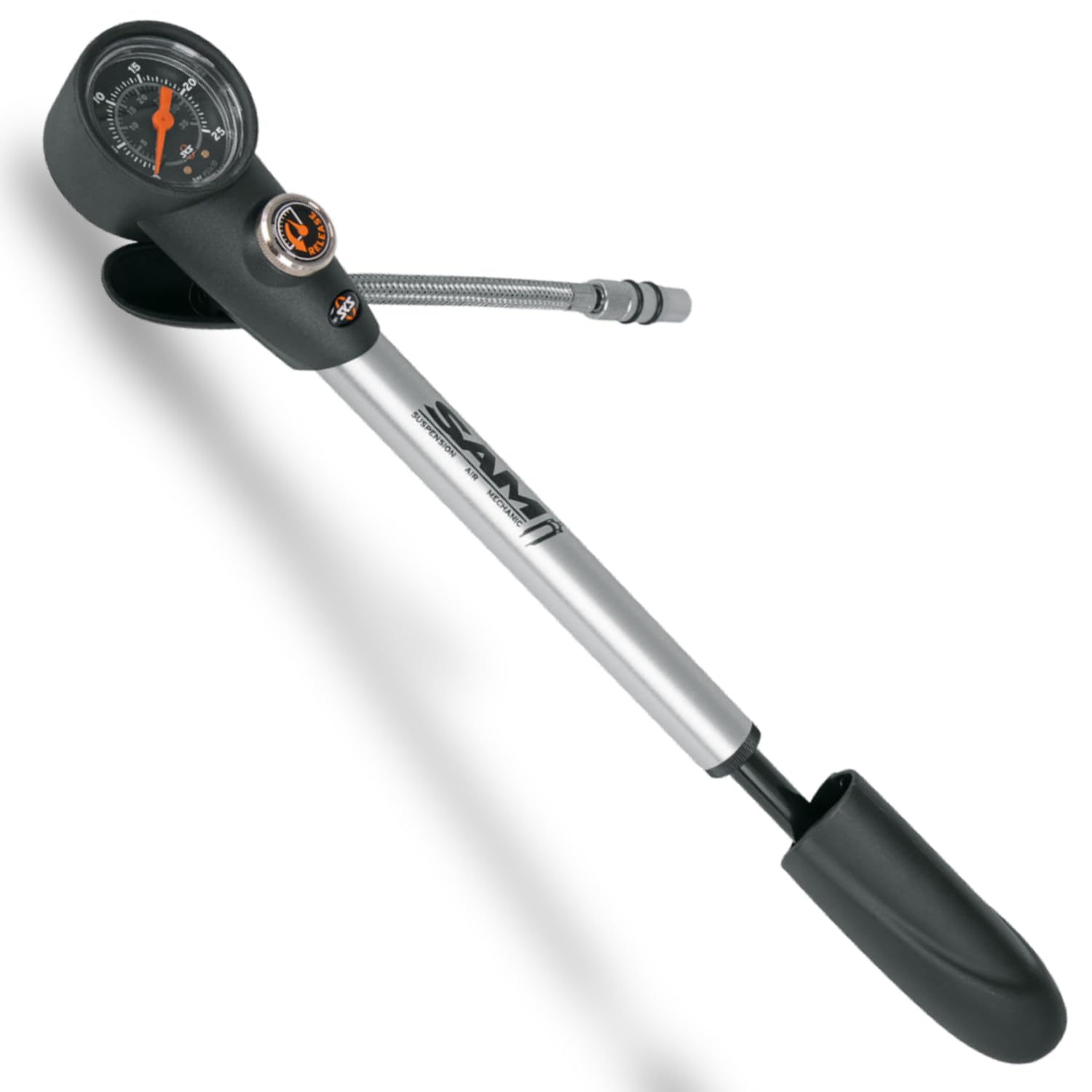
SKS Germany 360

SKS Germany 360

No-loss durability

Our Score 8.8/10
Check Price

Worth Noting

  • Gauge is very small and difficult to read, especially in bright outdoor conditions
Material
Metal
Max Pressure
360 PSI
Bleeder Valve
Yes
Read the full review

The SKS Germany pump employs a two-stage Schrader connector that measurably reduces air loss when disconnecting – a benefit over typical analog pumps. The metal body and steel-mesh swivel hose give it a premium feel that matches the price.

This pump suits riders who value sealing integrity over gauge readability. The small gauge is hard to read in bright sunlight, so precise pressure tuning requires careful sighting or a secondary gauge. It is not ideal for those who need quick, accurate readings on the trail.

Use in shade or with a separate gauge for accurate pressure checks.

Bottom line: A well-sealed pump for those who prioritize no-air-loss, but the tiny gauge demands extra attention for precision work.

9

Topeak DXG 360

Topeak DXG 360

Ultra-compact travel

Our Score 8.8/10
Check Price

Worth Noting

  • Air loss on disconnect persists despite Pressure-Rite connector
  • Some units may experience gauge inaccuracy or pumping issues after limited use
Material
Aluminum
Max Pressure
360 PSI
Bleeder Valve
Read the full review

The Topeak Pocket Shock DXG fits in a jersey pocket or pack, making it one of the most portable shock pumps available. Its aluminum body feels solid for a tool this small. However, air loss on disconnect remains noticeable despite the Pressure-Rite connector, which diminishes precision when setting sag. Additionally, some units may develop gauge inaccuracy or pumping issues after limited use. For bikepackers who prioritize saving space over workshop-level performance, this pump delivers on portability – just budget extra PSI to compensate for the air loss.

Bottom line: Best for riders who prioritize packability over precision and are willing to accept some air loss.

10

BETO 400 PSI Pump

BETO 400 PSI Pump

Ultra-budget spare

Our Score 8.8/10
Check Price

Worth Noting

  • Air pressure loss during operation and disconnect may require over-inflation to compensate
  • Quality control inconsistency means some units may have air leaks from the start
Material
CNC alloy
Max Pressure
400 PSI
Bleeder Valve
Read the full review

This pump inflates shocks and forks to high pressures without breaking the budget. The 400 PSI rating and alloy body look promising on paper. However, air loss can occur both during pumping and when disconnecting the nozzle, and some units arrive with leaks or poor seals. For an emergency spare or infrequent use in a toolbox, it gets the job done at the lowest cost. Those needing consistent accuracy or a pump they can count on ride after ride should look elsewhere.

Bottom line: Suits riders seeking a low-cost spare or emergency pump, but not for regular trail use where dependable pressure retention matters.

How to Choose

Maximum Pressure

Most mountain bike forks and rear shocks operate between 100 and 300 PSI. A pump rated for 300 PSI covers this range comfortably, with a larger dial that shows finer increments. Pumps rated for 600 PSI are necessary only for specialized shocks with IFP reservoir pressures or very high spring rates.

The trade-off: high-pressure pumps often have a smaller gauge with coarser markings (5 or 10 PSI per line), making it harder to set an exact pressure in the 200–250 PSI range. If you never need above 300 PSI, a 300 PSI pump gives you better readability.

Gauge Readability

An analog gauge's readability depends on its diameter and the spacing of its increments. A 1.5-inch dial with 1 PSI marks allows precise setting, while a tiny gauge on a 600 PSI pump may only show every 5 or 10 PSI. Digital displays eliminate this issue by showing 0.5 PSI resolution.

The hidden cost: small gauges are harder to read in bright sunlight or when mounted on the bike. If you tune in a workshop with good lighting, a coarse gauge is manageable. For trailside adjustments, a larger dial or digital readout saves time and frustration.

Air Loss on Disconnect

Every Schrader valve loses a small amount of air when you unscrew the pump head. That loss is caused by the valve core opening before the seal is fully broken. Some pump heads use a two-stage or lever-lock mechanism that purges the hose volume before releasing the valve, reducing loss to 1–2 PSI.

Standard heads typically lose 5–10 PSI. The only way to eliminate loss entirely is a digital pump that reads pressure at the valve and lets you disconnect with the hose still pressurised. For analog pumps, the practical fix is to over-inflate by 5 PSI and accept the drop.

Bleeder Valve Precision

A bleeder valve (or pressure-release button) lets you remove small amounts of air without disconnecting the pump. The precision of this valve matters: a micro-adjust bleeder releases air in tiny increments, while a simple push-button can dump 5–10 PSI in one press.

For fine-tuning sag, a precise bleeder is invaluable. Cheaper pumps often have a vague button that overshoots. Look for a clicky, gradual release if you plan to dial in pressure on the trail.

Build Material and Durability

The pump body, piston, and gauge housing see repeated high-pressure loads. Metal components (aluminum, steel) hold up better than plastic over hundreds of cycles. Plastic gauge housings and hose connectors are the first to crack or leak, especially in cold weather or after being dropped.

A pump with a metal barrel and brass or steel Schrader fitting will outlast a budget model with plastic parts by several seasons. The extra cost pays off if you use the pump more than a few times a year.

Frequently Asked Questions