Bikes

4 Best Trail Mountain Bike of 2026: Real Performance at Mid-Range Prices

Which trail mountain bikes deliver real performance without constant repairs? This guide picks the best full-suspension and hardtail options for beginners and intermediates.

A trail mountain bike that can't handle a root or rock is barely a bike. Many budget options arrive with misaligned gears, loose spokes, or bent wheels — turning your first ride into a troubleshooting session. The key is knowing which models balance price with reliable components rather than cutting corners.

This guide cuts through the noise to highlight bikes that consistently arrive in rideable condition. Whether you need a full-suspension model for rocky descents or a hardtail for cross-country climbs, these picks have proven themselves on real trails. A few extra dollars upfront on a mid-range bike avoids the headaches of cheap drivetrains and out-of-true wheels.

The best trail bike for you depends on your terrain and budget, not on glossy marketing specs.

1

Schwinn Traxion (full sus)

Top Pick
Schwinn Traxion (full sus)

Beginner to intermediate

Our Score 8.6/10
Check Price

Worth Noting

  • Front fork may be installed backwards from the factory
  • Drivetrain components can bend or break under heavier trail use, requiring periodic inspection
Gears
24-speed
Brake Type
Mechanical disc
Wheel Size
29 inches
Frame Material
Aluminum
Read the full review

The Schwinn Traxion pairs a full-suspension aluminum frame with 29-inch wheels and a 24-speed drivetrain, giving new riders the traction and gear range to handle moderate trail climbs and descents. Shifting between gears is smooth, and the mechanical disc brakes offer predictable stopping power on dry trails.

Assembly is straightforward, and once set up, the shifting and braking work well for most trail conditions. Some units arrive with the front fork rotated 180 degrees, but that is a simple fix. The drivetrain holds up for casual use, though heavier trail riding may require occasional tuning to keep the chain and derailleur in line.

This bike is best suited for beginner to intermediate riders between 5'7' and 6'2' who want a full-suspension platform without spending over $700. It is not for advanced riders needing high-end components, nor for those expecting a ready-to-ride bike straight from the box — careful assembly and initial tuning are essential.

Owner feedback consistently highlights the Traxion's ability to handle trail conditions that would overwhelm cheaper hardtails. The few reported drivetrain issues are manageable with regular maintenance, making this a viable gateway to full-suspension riding for budget-conscious newcomers.

Check the front fork orientation before the first ride — it may need to be rotated 180 degrees if installed backwards.

Bottom line: For new trail riders wanting full suspension without a big spend, the Traxion delivers — just plan an hour for setup and keep an eye on the drivetrain under harder riding.

2

AVASTA Earth 27.5"

AVASTA Earth 27.5"

Budget beginners

Our Score 8.4/10
Check Price

Worth Noting

  • Chain guard may need replacement under stress
  • Front derailleur may require adjustment after assembly
Gears
21-speed
Brake Type
Disc
Wheel Size
27.5 inches
Frame Material
Aluminum
Read the full review

The AVASTA Earth 27.5 combines an aluminum frame with disc brakes and a switchable front fork, delivering a solid entry-level platform for trail riding at a sub-$300 price point. The 21-speed drivetrain offers a wide gear range for climbs, and the 27.5-inch wheels roll over roots and rocks with reasonable stability. The lockout feature is particularly handy for paved sections, making this a capable commuter as well.

This hardtail targets budget-conscious beginners and casual riders who want disc brakes and a suspension fork without the expense of full-suspension models. Riders 5'4" and up will appreciate the standover height and responsive handling on light trails and gravel paths. Keep in mind that some units have arrived with missing chain guard parts or require front derailleur adjustment, so owners should be prepared to perform initial setup or source replacement components. For those willing to invest a little extra time in initial tuning, the Earth offers a cost-effective gateway to disc-brake trail riding.

Assembly is easy with basic tools, and the bike rides smoothly once the derailleur is dialed in. The switchable fork is a useful feature for mixed terrain, locking out firmly on pavement and opening up for moderate trail bumps. The disc brakes provide adequate stopping power for recreational use, though they may require a break-in period. Riders looking for a do-it-all starter bike will find few competitors at this price.

After assembly, inspect the chain guard bolts and tune the front derailleur for smooth shifting.

Bottom line: For riders seeking a disc-brake hardtail without the full-suspension price, this model delivers the essential trail features with a few setup caveats.

3

Mongoose Tyax Sport

Mongoose Tyax Sport

Cross-country / light

Our Score 8.4/10
Check Price

Worth Noting

  • Listing shows conflicting speed counts (18 vs 24-speed) which can cause confusion.
  • Some units may have cosmetic damage or frayed cables on arrival.
Gears
24-speed
Brake Type
Hydraulic disc
Wheel Size
29 inches
Frame Material
Aluminum
Read the full review

Hydraulic disc brakes and a 100mm front fork are uncommon at this mid-range price — the Tyax Sport pairs them with an aluminum frame that keeps weight low. That combination gives it an edge in stopping power over mechanical disc brakes, especially on descents or wet trails.

This hardtail fits cross-country riders and light trail enthusiasts who want predictable handling without rear suspension. The 29-inch wheels roll smoothly over obstacles, and the drivetrain offers a wide gear range for climbing. However, the product listing has a discrepancy — the title bullet shows 18-speed while the details section says 24-speed — creating uncertainty about what arrives. A small number of units have also been noted with cosmetic damage or frayed cables, so inspecting the bike on delivery is worthwhile.

Components like the hydraulic brakes and entry-level fork perform well for the price, giving riders a noticeable upgrade from bikes with budget mechanical discs. Those seeking a hardtail specifically for trail riding will find the Tyax Sport handles confidently, as long as the spec confusion doesn't change the value equation.

Check the product listing carefully for the actual speed configuration (18 or 24-speed) before ordering to avoid surprises.

Bottom line: If you want hydraulic disc brakes without paying for a full-suspension frame, the Tyax Sport is a capable choice — just verify the speed specs and inspect the bike upon arrival.

4

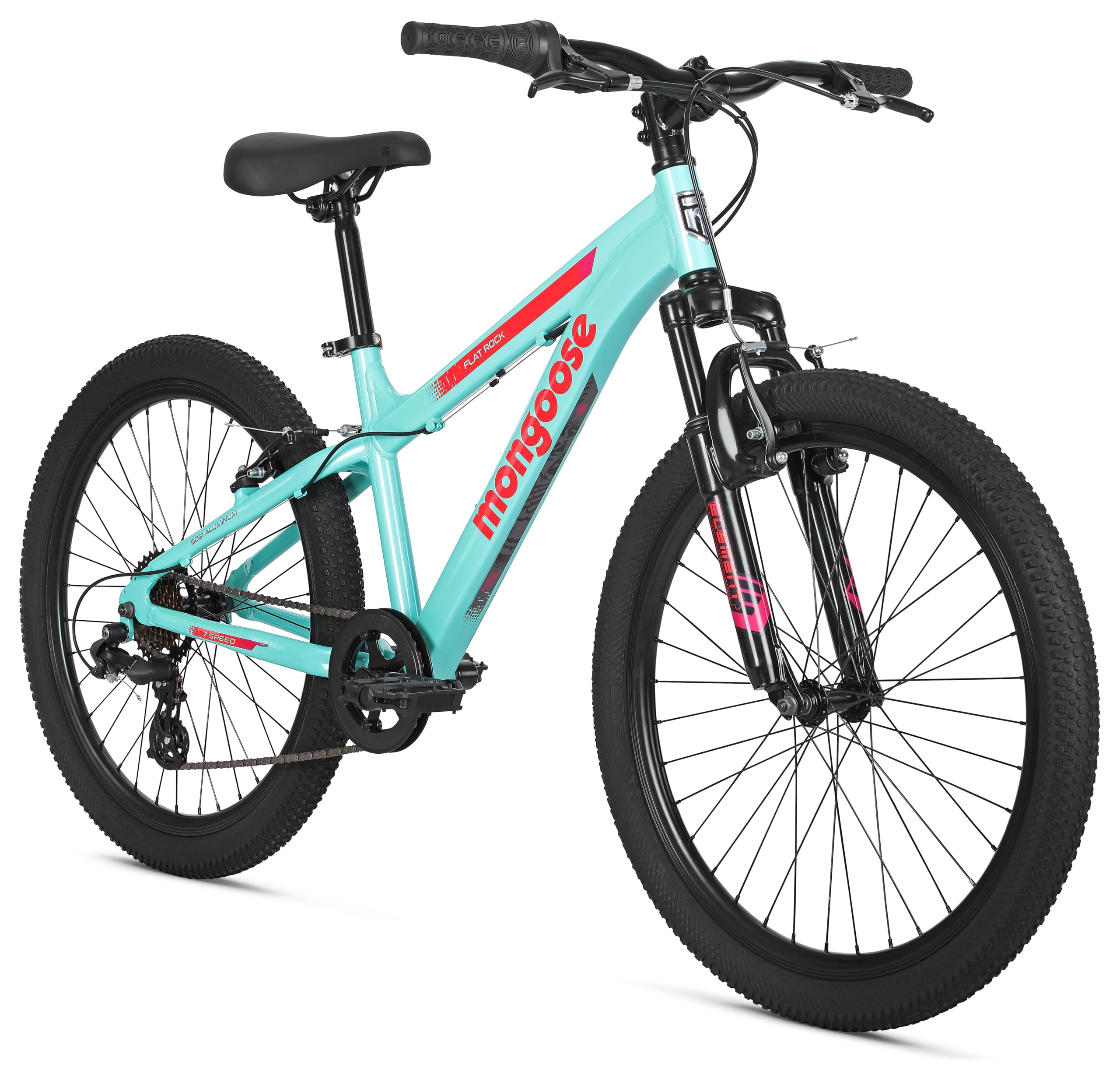
Mongoose Flatrock Youth

Mongoose Flatrock Youth

Youth riders

Our Score 8.0/10
Check Price

Worth Noting

  • 24-inch wheels and V-brakes make it unsuitable for adult trail riding.
  • Spokes, gears, and chain durability can require attention over time.
Gears
7-speed
Brake Type
V-brake (linear pull)
Wheel Size
24 inches
Frame Material
Aluminum
Read the full review

The Mongoose Flatrock delivers an affordable entry point for young riders with its aluminum frame, front suspension, and classic styling. The 24-inch wheels and V-brakes suit children ages 10-14 on paved paths or gentle dirt, making it a practical choice for family recreational use.

Anyone expecting a trail-ready mountain bike for adult riding will find the wheel size and component limits a clear mismatch. Spokes, gears, and chain may need attention over time, especially if the bike is used beyond its intended scope. This bike is best appreciated as a youth stepping stone, not a serious trail machine.

Bottom line: For parents seeking a budget-friendly first bike for a child aged 10-14, the Mongoose Flatrock offers decent value. For adult trail riding, look to models with 29-inch wheels and disc brakes.

How to Choose

Suspension Type

Hardtails have a rigid rear end and a front suspension fork; full-suspension bikes add a rear shock. Full suspension soaks up roots and rocks on descents, but budget dual-suspension frames are heavy and use basic shocks that add weight without real trail performance. On smooth or rolling terrain, a hardtail is lighter, more efficient, and easier to maintain.

Brake Type

Disc brakes (mechanical or hydraulic) provide consistent stopping power in mud and wet conditions, unlike rim brakes that lose grip on wet rims. Mechanical discs are cheaper but require more hand effort and frequent cable adjustments. Hydraulic discs offer one-finger stopping power and self-adjust, but are more expensive to replace. For trail riding, hydraulic discs are a significant upgrade over mechanical.

Wheel Size

27.5-inch wheels accelerate quickly and are more maneuverable, ideal for tight, technical trails. 29-inch wheels roll over obstacles more easily and maintain speed better on open terrain, but require a taller frame and can feel less agile. For most riders, 29-inch wheels are the standard for trail riding, while 27.5 suits shorter riders or those prioritizing playfulness. 24-inch wheels are only for youth bikes.

Gears

More gears (e.g., 24-speed) give a wider range for climbing steep hills and sprinting on flats, but budget drivetrains with low-quality derailleurs and shifters often skip gears or bend easily. A simpler 1x drivetrain (single front chainring) with a wide-range cassette reduces chain drops and maintenance, though it may lack the top-end speed of a 2x or 3x setup. For trail riding, a 1x or reliable 2x system with quality components is preferable to a cheap 3x.

Frame Material

Aluminum frames are lightweight and corrosion-resistant, standard for most trail bikes under $1000. Steel frames are heavier but absorb vibration and are more durable against impacts, often found on budget full-suspension bikes where weight is less of a concern. Carbon fiber is not available in this price range. For trail riding, aluminum offers the best balance of weight and strength.

Frequently Asked Questions