Bikes

6 Best Convertible Balance Bike of 2026: Stable in Every Mode

Find convertible balance bikes that stay stable in trike mode and grow with your child — without tipping or premature wear.

Convertible balance bikes promise a single ride-on that transforms from push trike to pedal bike. But many families discover that extra modes come with hidden trade-offs: a narrow rear wheelbase that tips in turns, pedals that hit heels, or handles that loosen after a few walks.

The best designs prioritize a wide enough wheelbase for stability, adjustable seat height that fits a two-year-old, and wheels that grip pavement without skipping. This guide focuses on the models that deliver on versatility without compromising safety.

Whether you need a parent push handle for strolls or a foldable frame for storage, the key is matching the bike's geometry to your child's size and your typical riding surface — not just counting modes.

1

JMMD 6-in-1 Foldable

Top Pick
JMMD 6-in-1 Foldable

Versatile all-in-one

Our Score 9.6/10
Check Price

Worth Noting

  • In push mode, the pedals stay stationary
  • Hand brake lever requires more force than most 3-year-olds can apply comfortably.
Conversion Modes
6
Wheel Type & Size
12" rubber
Wheelbase Stability
Stable
Parent Push Steering
Yes
Read the full review

The JMMD 6-in-1 converts between six riding modes — push trike, tricycle, balance bike, pedal bike, training wheels, and standard two-wheeler — all on a foldable aluminum frame. The hand brake is uncommon at this price tier and gives older toddlers an early feel for braking control.

Owners consistently highlight the bike’s stability and sturdy construction — the wide wheelbase and puncture-proof 12-inch rubber tires provide a planted feel in all modes. The foldable frame is a practical bonus for families with limited storage or those who transport the bike frequently. One area where the design shows its complexity is the push-mode pedals: they remain stationary while the parent pushes, which can delay a child’s understanding of pedaling compared to models with free-spinning pedals.

This bike suits parents who want a single purchase that adapts from an 18-month-old’s first ride to a 5-year-old’s independent biking. The adjustable seat and handlebar, plus the parent push handle, make it practical for early years. However, if your primary goal is to teach pedaling skills as early as possible, the stationary pedals in push mode may be a frustration — the bike is better suited for families who prioritize mode variety and foldability over perfect pedal transmission.

Let your child ride in pedal mode when they show interest in pedaling — the stationary pedals in push mode work fine as footrests.

Bottom line: For families wanting one adjustable bike that spans toddlerhood to preschool, the JMMD 6-in-1 delivers the widest mode range and a stable ride. The stationary-pedal tradeoff means it's best for those who value adaptability over early pedal training.

2

LOL-FUN 4-in-1

LOL-FUN 4-in-1

Ultra-budget 4-in-1

Our Score 9.6/10
Check Price

Worth Noting

  • Heel strike against rear wheels can limit pedal stroke for some children
Conversion Modes
4
Wheel Type & Size
Plastic/rubber
Wheelbase Stability
Unstable
Parent Push Steering
No
Read the full review

This 4-in-1 offers snap-together assembly and a playful design that appeals to toddlers aged 10–18 months. The price makes it an accessible first ride-on for families watching their budget. However, the narrow rear wheelbase creates instability in trike mode, making it prone to tipping during turns — a limitation that limits safe use to indoor surfaces and low-speed, flat outdoor spaces.

Bottom line: Suitable as a low-cost first ride-on for very young toddlers who will use it indoors or on smooth, flat surfaces where tipping is less of a concern.

3

Yvolution Flippa 3-in-1

Yvolution Flippa 3-in-1

Premium parent steering

Our Score 9.4/10
Check Price

Worth Noting

  • Converting to balance bike mode can be finicky
  • Minimum seat height of 13 inches may be too tall for toddlers with shorter legs
Conversion Modes
3
Wheel Type & Size
Wheelbase Stability
Stable
Parent Push Steering
Yes
Read the full review

The Yvolution Flippa delivers the most refined parent steering experience in this class, with a smooth, direct connection to the front wheel that makes walks with a toddler feel effortless. The aluminum frame keeps weight manageable without sacrificing rigidity. Where the top pick offers six modes and a hand brake, the Flippa focuses on nailing the core tricycle and balance bike modes with better steering feedback.

This trike suits parents who prioritize build quality and precise steering control over sheer mode count. The seat adjusts to a minimum height of 13 inches, so children need at least a 13-inch inseam to place feet flat on the ground — younger toddlers with shorter legs may find it too tall. Converting from trike to balance bike mode involves a rear wheel flip mechanism that can be fiddly, but practicing the sequence a few times makes it manageable.

Keep the instruction manual handy for mode conversions; the rear wheel flip sequence is easier with a clear reference.

Bottom line: A well-built 3-in-1 with the best parent steering in its category — best for toddlers who already meet the 13-inch seat height requirement.

4

Y Velo Junior 2-in-1

Y Velo Junior 2-in-1

Stability balance training

Our Score 9.4/10
Check Price

Worth Noting

  • At over 8 lbs, the bike may be too heavy for some 18-month-olds to lift and steer
  • Front wheel bearing can develop wobble after a few months, requiring occasional checks
Conversion Modes
2
Wheel Type & Size
9" aluminum/plastic
Wheelbase Stability
Very stable
Parent Push Steering
No
Read the full review

The Y Velo Junior stands out for its dual rear wheel design, which gives toddlers a wider, more forgiving base when learning to balance. At under 8.5 lbs, it is light enough for most 18-month-olds to scoot around, and the frame holds up to daily use without bending or cracking. Assembly takes minutes, and the seat and handlebar adjust to grow with a child up to 44 lbs.

This model is a pure balance bike — it does not convert to a tricycle or pedal bike. Families who want those extra modes will prefer the top pick (JMMD). But if stability is the top priority and conversion is not needed, the Y Velo offers a no-frills, stable ride. One limitation to keep in mind: the front wheel bearing can develop wobble after a few months of use, so occasional inspection is wise. Also, at over 8 lbs, very small toddlers may find it a bit heavy to lift and steer independently.

If your child is under 2 years old, check that they can comfortably lift the bike before buying.

Bottom line: For families who want a stable balance bike without conversion modes, the Y Velo is a solid choice — just keep an eye on the front wheel bearing over time.

5

newyoo 5-in-1 + Safety Belt

newyoo 5-in-1 + Safety Belt

Safety harness adjustable

Our Score 9.2/10
Check Price

Worth Noting

  • Parent steering handle may develop wobble with extended use, affecting control precision.
  • Handlebar durability can be inconsistent
Conversion Modes
5
Wheel Type & Size
EVA shock-absorbing
Wheelbase Stability
Stable
Parent Push Steering
Yes
Read the full review

The newyoo 5-in-1 stands out with its padded seat, removable backrest, and safety harness — features that make it the most adjustable option for very young toddlers. Assembly takes minutes with clear instructions, and the seat, handlebar, and backrest adjust to accommodate growth. Unlike the 6-mode leader, this model prioritizes comfort and security over parent steering precision; the push handle can become loose over time, reducing control.

This trike fits families with a child aged 1-3 who benefits from the harness and backrest for a secure ride. Parents who plan to rely on the push handle for long, confident walks should be aware that the handle may develop wobble, making it less suited for that use case. For short strolls and toddler-led exploration, the versatility and safety extras deliver real value.

Check the steering handle tightness periodically to maintain control.

Bottom line: A strong option for parents who want maximum adjustability and safety extras for their toddler. If stable parent steering is critical, the top pick handles better.

6

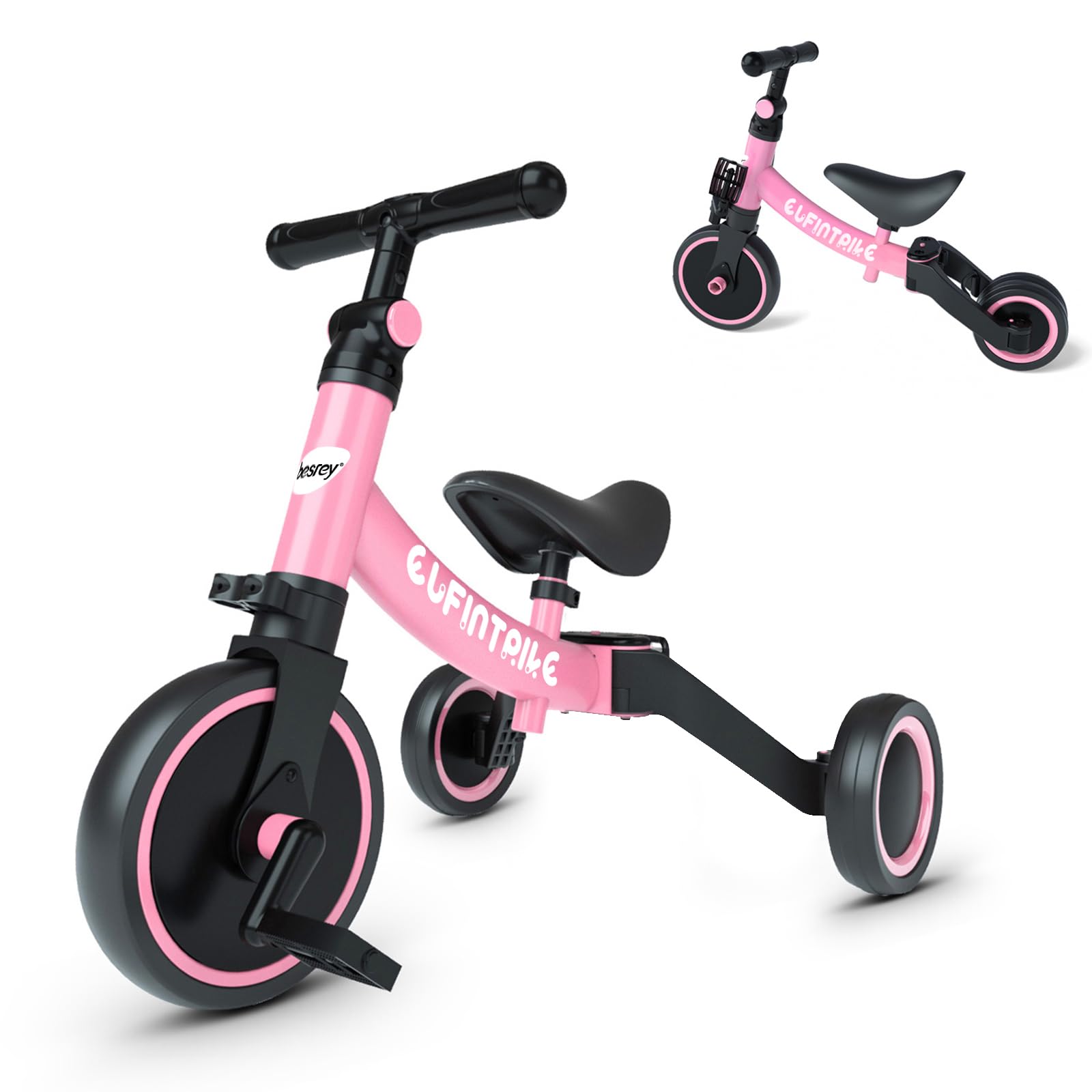
besrey 5-in-1 Budget

besrey 5-in-1 Budget

Budget small toddler

Our Score 9.0/10
Check Price

Worth Noting

  • Seat height range is short
  • Handlebar tightening screw may not secure fully, allowing some steering play over time
Conversion Modes
5
Wheel Type & Size
12" EVA foam
Wheelbase Stability
Stable
Parent Push Steering
No
Read the full review

The besrey 5-in-1 stands out among budget convertible bikes for its simple assembly and light frame — no parent steering or complex hardware to manage. It is best suited as a first ride for toddlers between 12 and 18 months who are on the smaller side. For children approaching two years, leg room becomes tight, and the pedals may remain out of reach even at the highest seat setting.

Once assembled, the bike rolls smoothly on foam wheels and transitions between trike and balance modes by removing the pedals. The seat and handlebars adjust without tools, which makes it easy to fine-tune the fit as a child grows those first few months. Build quality holds up well across multiple children in casual use.

Check the handlebar clamp screw occasionally — a dab of thread-locker can prevent gradual loosening.

Bottom line: A solid buy if your toddler is petite and under 18 months, but plan to upgrade once they hit the two-year mark.

How to Choose

Number of Conversion Modes

More modes mean more ways to ride, but each added mode introduces extra connection points that can loosen over time. A 6-in-1 bike may offer push trike, balance, and pedal modes, but the base geometry (wheelbase and seat height) determines whether those modes are actually usable.

Focus on the modes you'll realistically use: a parent push handle for walks, a balance bike phase, and a pedal option. Models that skip the push handle often trade convenience for a lower price, but you lose the ability to steer during strolls.

Parent Steering Control

A push handle that only pushes straight ahead offers limited control. The best designs connect the handle to the front wheel via a steering linkage, letting you guide the bike around obstacles. Without this linkage, the child steers independently and the parent handle becomes a simple tow bar.

Check that the handle stays rigid during use; models with wobbly steering handles (reported in several mid-range options) reduce confidence and can frustrate both parent and toddler.

Wheel Material and Size

Rubber wheels provide better traction on pavement and absorb bumps, but add weight and cost. EVA foam wheels are quieter and lighter, but wear faster and offer less grip on slick surfaces. For primarily indoor or smooth sidewalk use, foam is adequate; for mixed terrain, rubber is safer.

Wheel size also affects curb-climbing ability. 12-inch wheels roll over small obstacles more easily than 9-inch wheels, making them more suitable for older toddlers who venture onto grass or gravel.

Stability and Wheelbase

A wide rear wheelbase (measured across the rear wheels or training wheels) prevents tipping during sharp turns in trike mode. Many budget models narrow the wheelbase to keep cost down, resulting in instability that becomes apparent on the first turn.

The most stable bikes have a wheelbase that keeps the center of gravity low and balanced. If the bike feels tippy during a test push or if reviews mention tipping, it's a sign the geometry compromises safety for appearance.

Frequently Asked Questions