Indoor Training

6 Best Smart Bike Trainer of 2026: Find the One with Stable Wi-Fi

Which smart bike trainers deliver reliable Wi-Fi for uninterrupted Zwift rides, and which ones leave you disconnected mid-climb?

Most smart bike trainers connect via Bluetooth, but during hour-long virtual rides, that connection can drop — usually at the worst moment. A few models now include Wi-Fi, which keeps the signal solid even when phones, sensors, and laptops are all connected. The trade-off: Wi-Fi trainers cost more, and many otherwise capable direct-drive options skip it to keep the price down.

This guide focuses on the connectivity choice first, then weighs the other specs that actually affect your indoor riding: drive type, gradient simulation, noise, and power accuracy. Whether you ride Zwift every day or just want to spin through winter, the right trainer depends on how much you value a never-drop connection versus upfront savings.

The most overlooked spec isn't max power — it's how your trainer talks to the app. Wi-Fi gives you consistent data and resistance changes; Bluetooth leaves you crossing your fingers. That single difference separates the best all-around trainers from the rest.

1

Tacx Neo 2T

Top Pick
Tacx Neo 2T

Serious cyclists

Our Score 9.4/10
Check Price

Worth Noting

  • At 47 pounds, it's heavier than many direct-drive trainers, making relocation awkward.
Drive Type
Direct Drive
Connectivity
ANT+, BLE (no Wi-Fi)
Power & Gradient
2200W, 25% grade
Read the full review

Unmatched road feel and near-silent magnetic resistance set the Tacx Neo 2T apart from any direct-drive trainer under $1,200. It simulates road vibration and inertia more naturally than the top pick, and integrates smoothly with Garmin Connect and Zwift via Bluetooth or ANT+. The tradeoff is that it lacks Wi-Fi, so connection stability depends on your device's Bluetooth range and interference — something to consider for riders who do long sessions. This trainer is ideal for serious cyclists who prioritize ride realism and are comfortable with Bluetooth/ANT+ connectivity, especially those already in the Garmin ecosystem.

Bottom line: If realistic indoor riding is your priority, the Tacx Neo 2T delivers an experience no other trainer matches.

2

ThinkRider XXPRO

ThinkRider XXPRO

Self-powered use

Our Score 9.4/10
Check Price

Worth Noting

  • Noise level increases in self-powered mode
  • Does not fully support Zwift’s virtual shifting feature.
Drive Type
Direct Drive
Connectivity
ANT+, BLE
Power & Gradient
2500W, 25% grade
Read the full review

The ThinkRider XXPRO can run without a wall outlet — a rare feature for any smart trainer, let alone a budget-friendly direct-drive. That self-power mode delivers up to 2500W resistance, which covers everything from sprints to steep simulated climbs. In a garage where running a cord is inconvenient, this is a genuine advantage over the quieter, simpler direct-drive option in this roundup. Setup is quick, and the build feels solid for the price. The tradeoff: when running on its own power, the motor hum is noticeable — fine in a basement but distracting in a living room. Zwift riders should also note that virtual shifting isn’t fully supported, so app-based gear changes may feel less seamless.

Keep it plugged into AC when possible for quieter operation; reserve self-power for sessions away from an outlet.

Bottom line: Best for riders who need a trainer that works without a nearby outlet or demand high power on a budget — just plan for a garage or basement setup to keep the noise out of shared spaces.

3

Wahoo KICKR CORE 2

Wahoo KICKR CORE 2

Zwift riders

Our Score 9.0/10
Check Price

Worth Noting

  • Some units may arrive missing small mounting bolts
  • The Zwift Click controller has limited compatibility with non-Zwift apps like Rouvy; you may need to use standard shifting for those sessions.
Drive Type
Direct Drive
Connectivity
Wi-Fi, ANT+, BLE
Power & Gradient
~1800W, gradient N/A
Read the full review

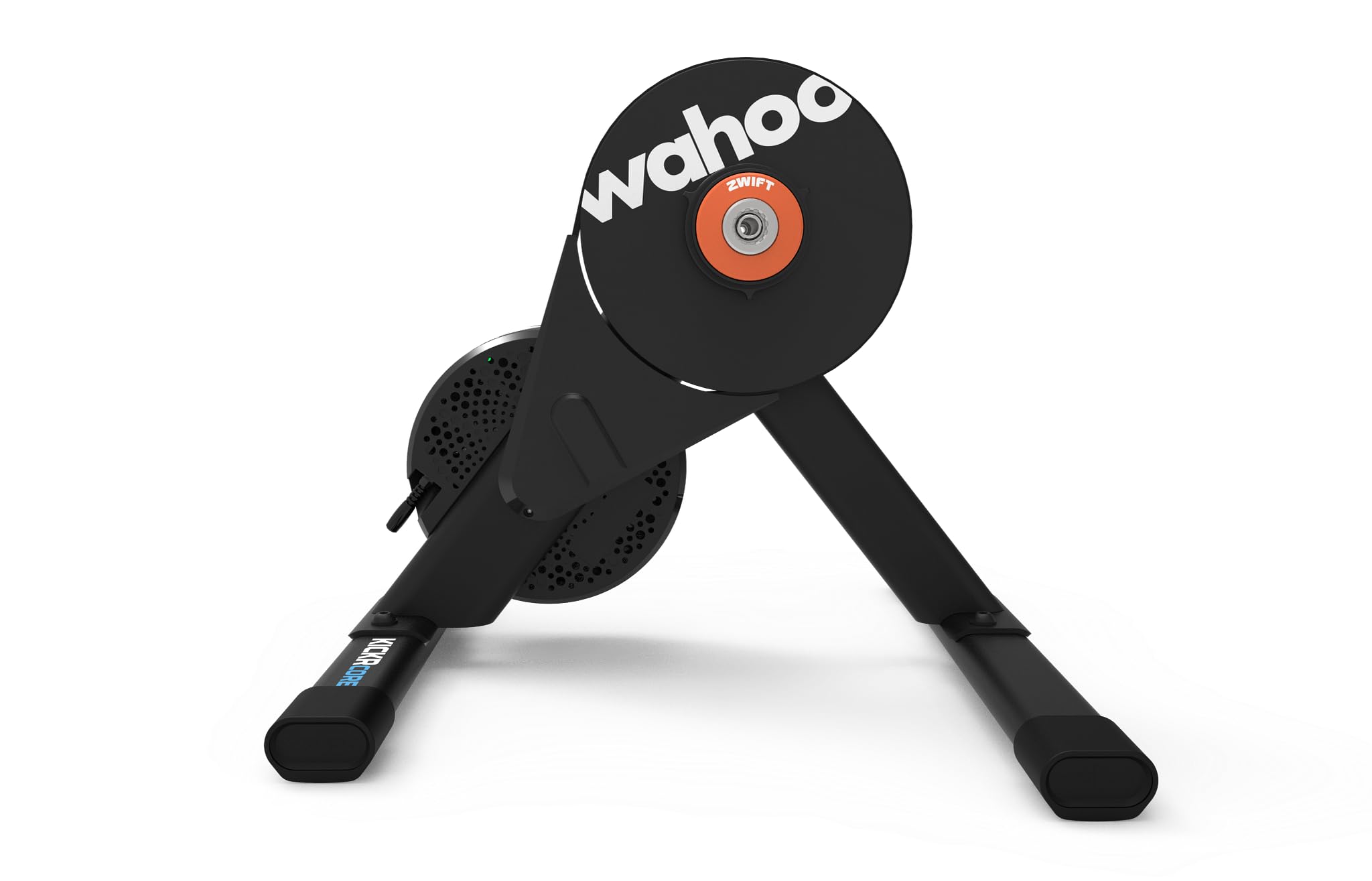
The Wahoo KICKR CORE 2 sets itself apart with built-in Wi-Fi, removing the Bluetooth dropouts that interrupt long Zwift sessions. Pairing is simple, and the included Zwift Cog and Click system delivers smooth, consistent resistance changes without touching your bike's derailleur. Setup takes under 15 minutes, and the resistance responds accurately to virtual gradients, making indoor rides feel natural.

This trainer is purpose-built for Zwift riders who want a no-hassle indoor training experience. The Click controller works intuitively within Zwift but has limited support on platforms like Rouvy — expect to use standard ANT+/BLE shifting for those apps. Beginners will appreciate the simple calibration and stable connection, though occasional packaging inconsistencies mean it's worth checking the box for all mounting hardware during setup.

If you train on multiple apps, the standard ANT+/BLE shifting works with any platform — the Click controller is optional outside Zwift.

Bottom line: For Zwift-focused riders who want a Wi-Fi-connected direct-drive that works right out of the box, the KICKR CORE 2 offers the most complete package at a mid-range price.

4

ThinkRider X2Max

ThinkRider X2Max

Budget riders

Our Score 8.8/10
Check Price

Worth Noting

  • On steep virtual climbs over 18%, the trainer cannot simulate the full grade
  • 240 lb weight capacity excludes heavier cyclists
Drive Type
Direct Drive
Connectivity
ANT+, BLE
Power & Gradient
2000W, 18% grade
Read the full review

The ThinkRider X2Max stands out among budget direct-drive trainers for its quiet 58 dB operation — low enough for apartment use. Setup takes minutes, and Bluetooth/ANT+ pairing is stable across Zwift, Rouvy, and MyWhoosh. The tradeoff: maximum gradient simulation stops at 18%, which feels flat on steep climbs like Alpe du Zwift, and the 240 lb weight limit rules out heavier riders. This makes the X2Max best suited for cyclists who ride mostly flat or rolling terrain indoors and want a no-fuss, wallet-friendly direct-drive option.

Bottom line: A cost-effective pick for riders who prioritize quietness and ease of use over maximum gradient simulation.

5

Saris M2

Saris M2

Entry budget

Our Score 8.2/10
Check Price

Worth Noting

  • Assembly process can be finicky due to tight tolerances in the carriage bolt alignment.
  • Resistance consistency may degrade after extended sessions, requiring recalibration.
Drive Type
Wheel-on
Connectivity
ANT+ FE-C, BLE
Power & Gradient
±5% accuracy
Read the full review

The Saris M2 delivers electromagnetic resistance and app connectivity at a price point under $200, making it the most accessible path into structured indoor training. Assembly can be finicky due to tight carriage bolt tolerances, and the unit is noticeably loud in quiet spaces — fine for a garage but not for an apartment. Some units may lose resistance after extended rides, requiring recalibration. This trainer suits cyclists on a tight budget who have a dedicated training area and are comfortable with a bit of hands-on setup.

Keep a hex wrench handy for the initial assembly — allowing extra time for alignment helps avoid frustration.

Bottom line: This is the trainer for budget-focused riders who have a workspace they can dedicate to training and don't mind occasional calibration.

6

Saris Fluid2

Saris Fluid2

Basic training

Our Score 8.0/10
Check Price

Worth Noting

  • Connecting to apps requires a separate speed/cadence sensor, adding cost and complexity.
Drive Type
Wheel-on
Connectivity
Power & Gradient
Read the full review

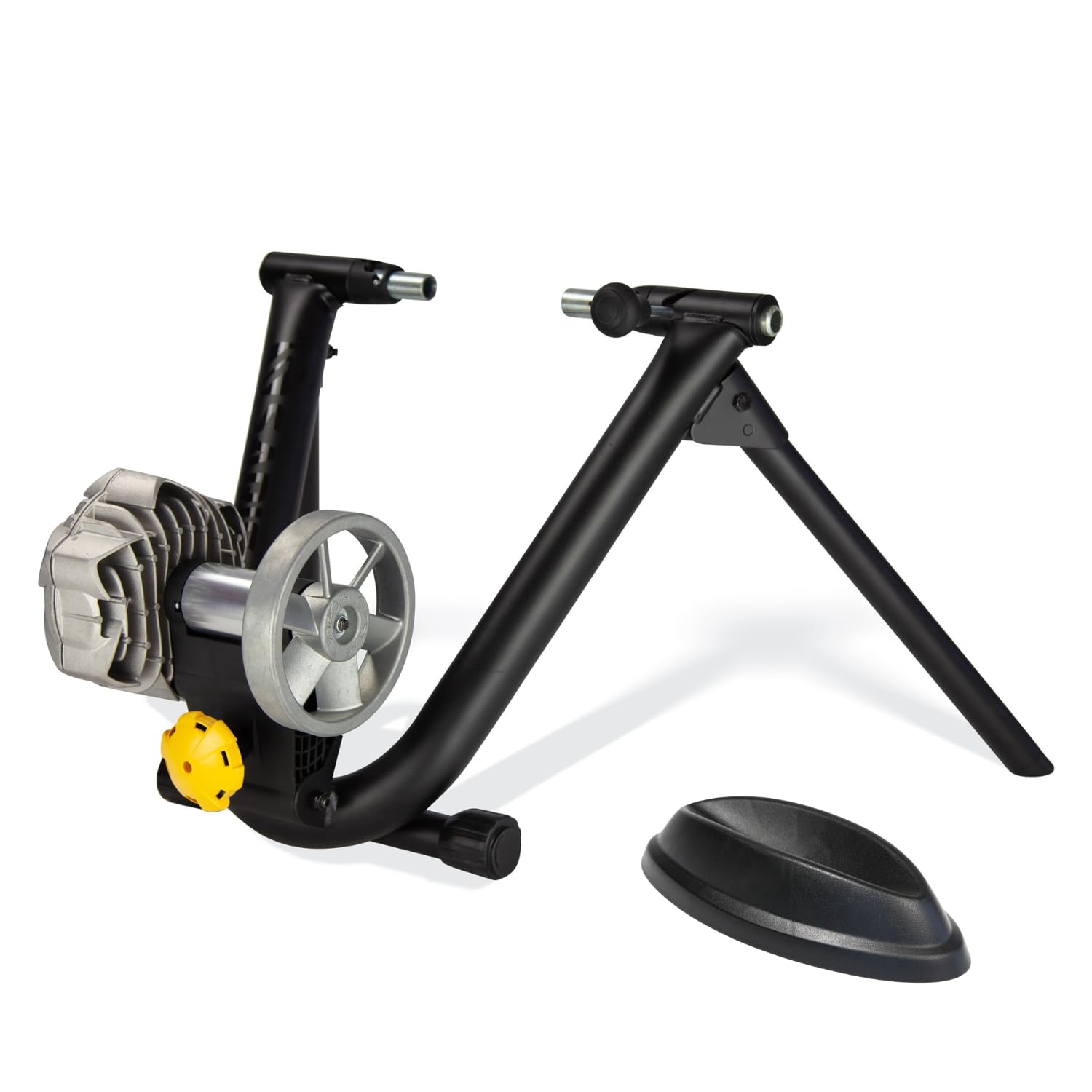
The Saris Fluid2 delivers sturdy fluid resistance that mimics outdoor climbing at a budget-friendly price. But it's not a smart trainer — there's no electronic resistance control, and connecting to apps requires a separate speed/cadence sensor (sold separately). This is a good fit if you already own that sensor and want a simple, durable trainer for basic indoor riding without smart features.

Bottom line: Ideal if you already own a speed/cadence sensor and want a dependable fluid trainer without electronic gimmicks; skip this if you need automatic resistance control for app training.

How to Choose

Drive Type

Direct-drive trainers remove the rear wheel and attach the bike directly to the unit. This design eliminates tire slip, improves power accuracy, and runs quieter than wheel-on models. Wheel-on trainers press a roller against the tire, which wears the tire and creates more noise.

For regular indoor training, direct-drive is the clear winner. The added cost is offset by better consistency and less maintenance. Wheel-on models still make sense for occasional use or very tight budgets, but expect to calibrate more often and accept lower precision.

Power & Gradient

Max power (watts) determines how much resistance the trainer can apply at high speeds. Most riders never exceed 1500W, so a 2000W+ capacity is plenty. Gradient simulation — measured in percent — is more important for virtual climbing. A trainer limited to 18% feels flat on steep routes like Alpe du Zwift.

If you ride mostly flat or moderate terrain, 18% is fine. For serious climbers or anyone who wants realistic hill repeats, look for 20% or higher. The actual wattage you need depends on your fitness; the gradient is what makes the ride feel real.

Connectivity

Bluetooth and ANT+ work for most trainers, but they share the 2.4GHz band with Wi-Fi networks, causing occasional dropouts. Wi-Fi connectivity uses a separate dedicated channel, providing a stable link throughout long rides. This matters most when running Zwift alongside sensors, a phone, or a smart TV.

Trainers with Wi-Fi are typically $100–$200 more than Bluetooth-only equivalents. The investment pays off for riders who frequently experience disconnections or train in crowded wireless environments. For short sessions in a quiet room, Bluetooth is usually sufficient.

Frequently Asked Questions